















Newsletter
Last published articles
Calendar
Login
All articles
14 August 2012
MSC FLAMINIA : Accueil des navires en détresse dans les eaux de l'Union Européenne : Oui, mais à condition que le navire soit en bon état......


- Article Details
- Published on 14 August 2012
- Category Major cases
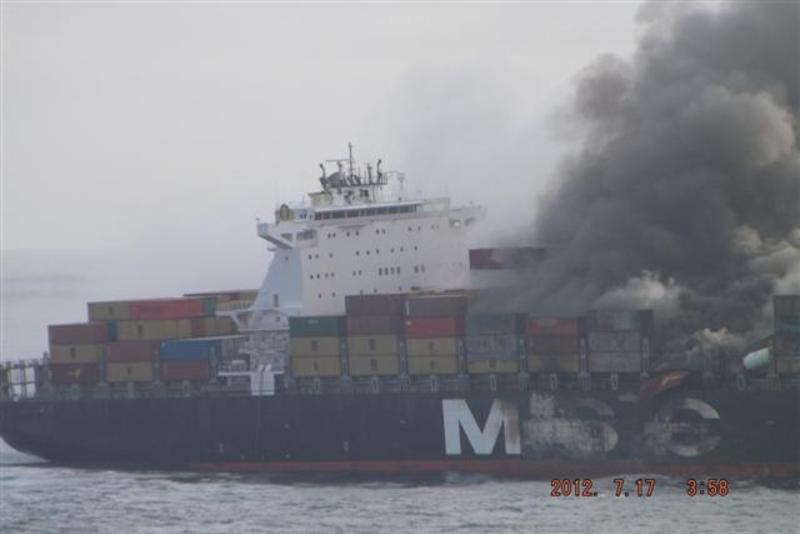
.jpg) Un porte conteneurs MSC en feu après une explosion à bord, abandonné par son équipage en plein Atlantique, nous avions là les ingrédients pour une nouvelle histoire à raconter sur notre site. Même si il n'avait rien d'exceptionnel, ce nouveau sinistre illustrait à nouveau que le transport de marchandises par mer peut encore s'avérer dangereux. L'incendie qui a éclaté à bord le 14 juillet dernier dans la cale nº 4 du navre , et a causé la mort de deux marins, et blessé trois autres, a été suivi de deux explosions les jours suivants dans les cales 5 et 6. Après quelques heures de flottement (normal en de pareils circonstances, et surtout lorsque l'équipage a abandonné le navire), la situation a été reprise en main par l'armateur (NSD REDEREI) et plusieurs remorqueurs de haute mer ont pu se porter au secours du navire et engager la lutte contre l'incendie qui continuait de dévorer le navire.
Un porte conteneurs MSC en feu après une explosion à bord, abandonné par son équipage en plein Atlantique, nous avions là les ingrédients pour une nouvelle histoire à raconter sur notre site. Même si il n'avait rien d'exceptionnel, ce nouveau sinistre illustrait à nouveau que le transport de marchandises par mer peut encore s'avérer dangereux. L'incendie qui a éclaté à bord le 14 juillet dernier dans la cale nº 4 du navre , et a causé la mort de deux marins, et blessé trois autres, a été suivi de deux explosions les jours suivants dans les cales 5 et 6. Après quelques heures de flottement (normal en de pareils circonstances, et surtout lorsque l'équipage a abandonné le navire), la situation a été reprise en main par l'armateur (NSD REDEREI) et plusieurs remorqueurs de haute mer ont pu se porter au secours du navire et engager la lutte contre l'incendie qui continuait de dévorer le navire.
Passé quelques jours, le feu était circonscrit et maîtrisé (pas éteint) et des membre de l'équipe de sauvetage ont pu se rendre à bord, notamment pour remettre en fonctionnement les équipements anti-incendie.
Notre première réflexion était alors de dire que ce dossier était terminé avant même d'avoir vraiment commencé que nous n'aurions alors plus rien à nous mettre sous la dent.
Pourtant, très rapidement, quelque chose est apparu comme ne tournant finalement pas très rond. Comme souvent, le lièvre fut assez rapidement soulevé par Mikhail Voytenko, du site odin.tc. Suivant la trajectoire du navire lorsque la position du navire était disponible, scrutant (comme nous), les communiqués de presse de NSB REDEREI (aux contenux assez peu explicitex sur le devenir du navire), il est devenu rapidement évident qu'un problème important empêchait le navire de poursuivre sa route et de rejoindre un port.
20 July 2012
Incendie du MSC FLAMINIA
- Article Details
- Published on 20 July 2012
- Category Major cases
Summary : On the 14 July 2012, while enroute from Charleston to Antwerp, the container ship MSC FLAMINIA suffered an fire on board (in containers). Despite the efforts of the crew, an explosion occured, which caused a udge fire. The crew of NSB Niederelbe's 6,732-teu MSC Flaminia (built 2001) have abandoned ship with four of the 25 seafarers reported to have suffered injuries and one missing. A rescue team attend the vessel (SMIT SALVAGE). After many efforts, vessel was salvaged and attended the port of Wilhelmshaven (Germany). Many questions are still pending, particularely regarding the application of the EU Directive about "port refuge".
Vessel & Interveners
| 1 - IMO NUMBER | 9225615 | 2- NAME OF SHIP | MSC FLAMINIA |
| 3 - Call Sign | DHZR | 4 - MMSI | 211378120 |
| 5 - Tonnage Brut | 75590 | 7 - DWT | 85823 |
| 8 - Type de navire | Container Ship | 9 - Status of Ship | Casualty |
| 9 - Flag | Germany | 9- Year of build | 2001 |
| 10 - Propriétaire déclaré | MSC FLAMINIA | 10-1 Address |
Care of NSB Niederelbe Shiffahrtsgesellshaft mbh & Co KG, Harburger Strasse 47-51, 21614 Buxtehude Germany |
|
11 - Ship Manager |
NSB NIEDERELBE SHIFFAHRTSGES |
11-1 Address |
Harburger Strasse 47-51 21614 Buxtehude Germany |
|
12 - ISM Manager
|
NSB NIEDERELBE SHIFFAHRTSGES |
12 -1 Address
|
Harburger Strasse 47-51 21614 Buxtehude Germany |
|
13 - Classification Society
|
Germanisher Lloyd |
14 - P&I |
|
|
15- Hull Insurers
|
Swedish Club (as leader) |
16 - Salvors |
Location of the casualty
Pictures




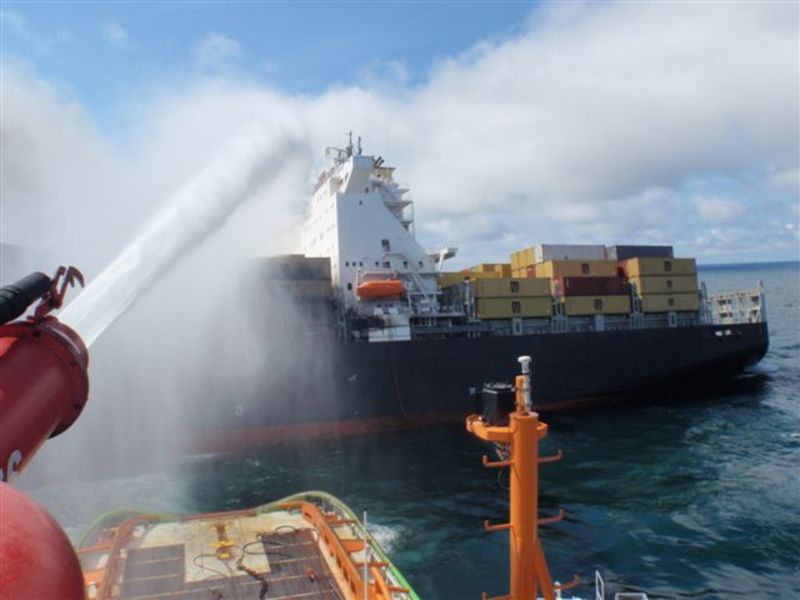
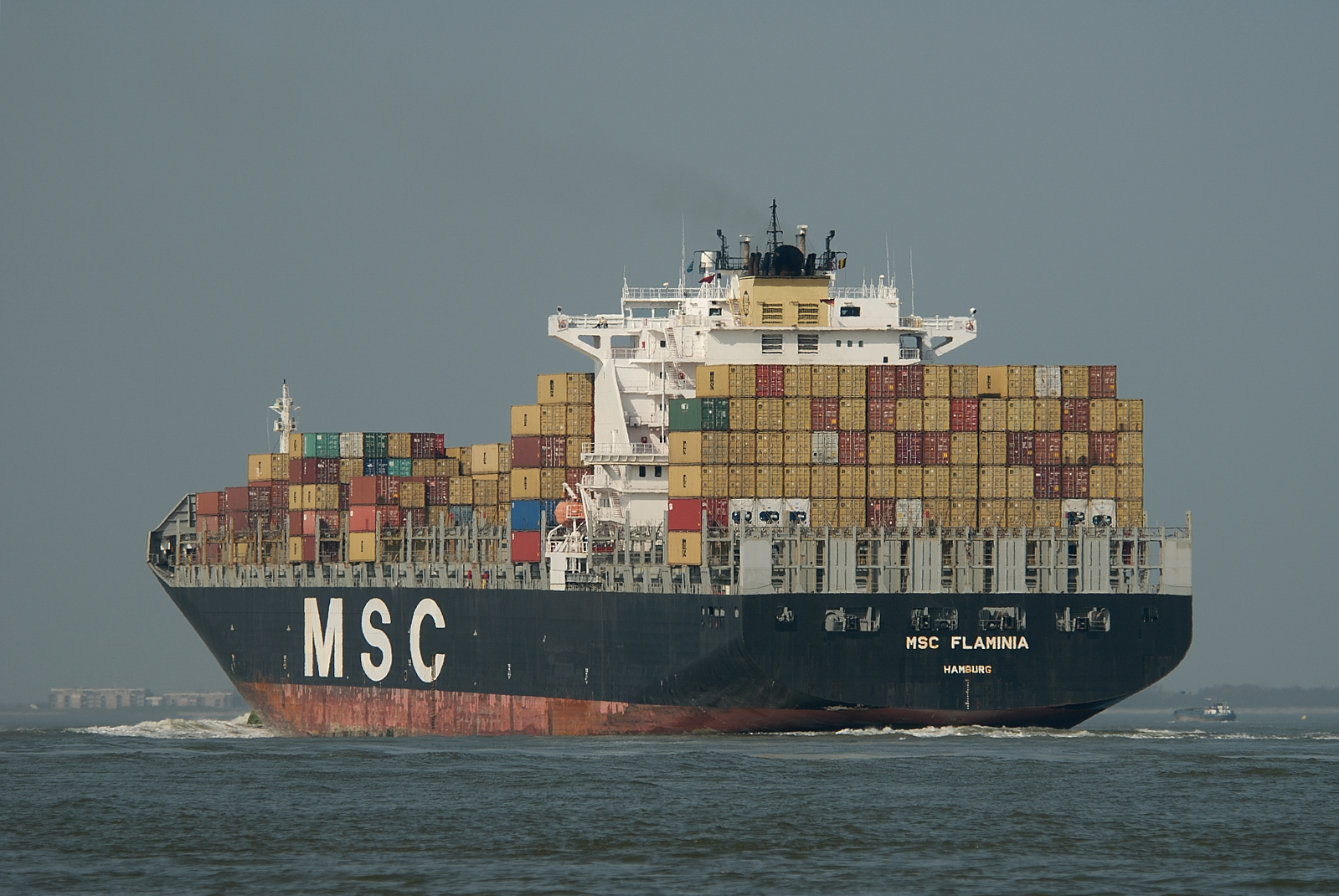
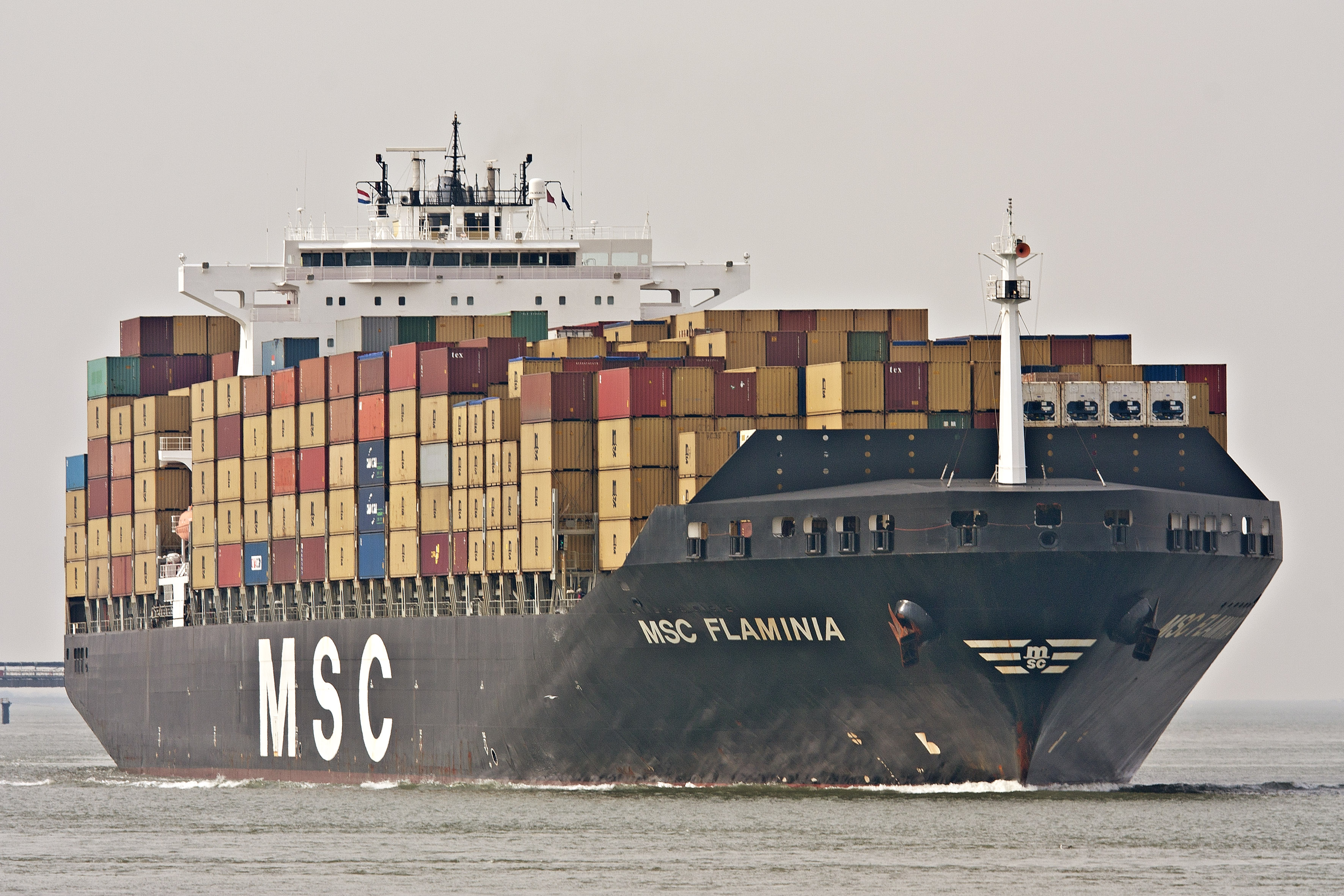


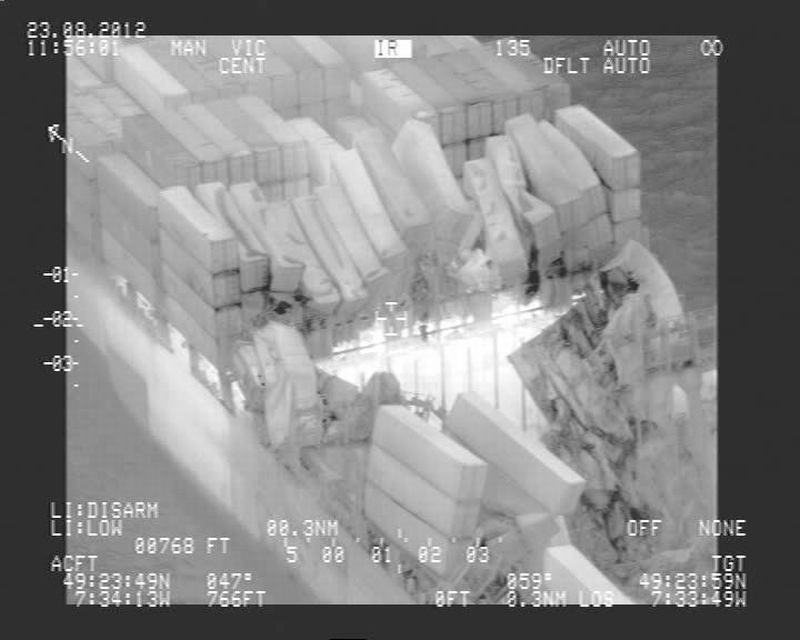
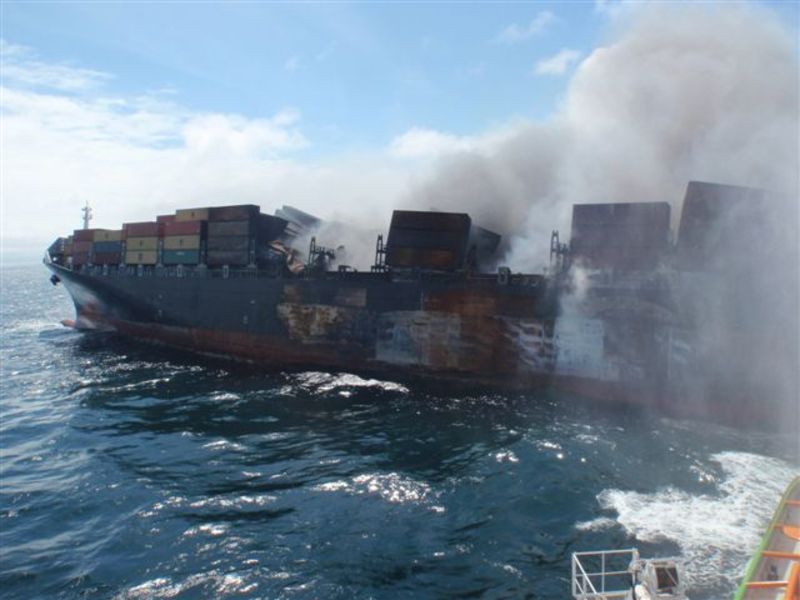
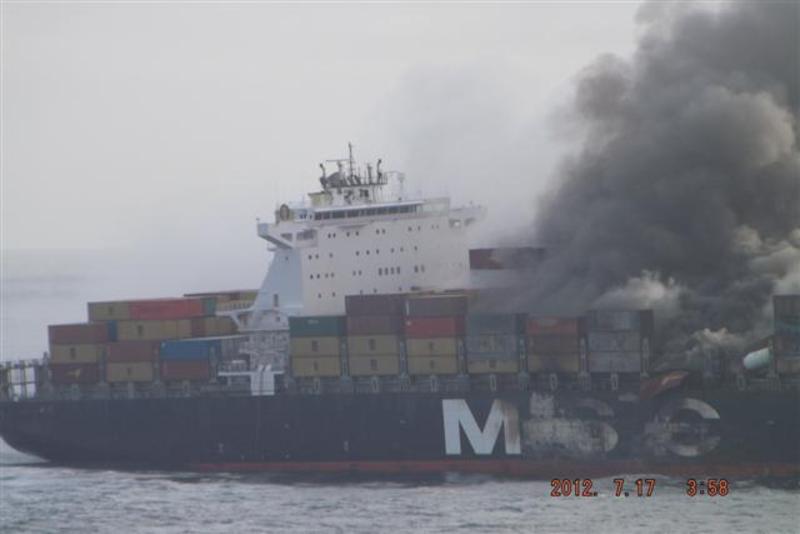
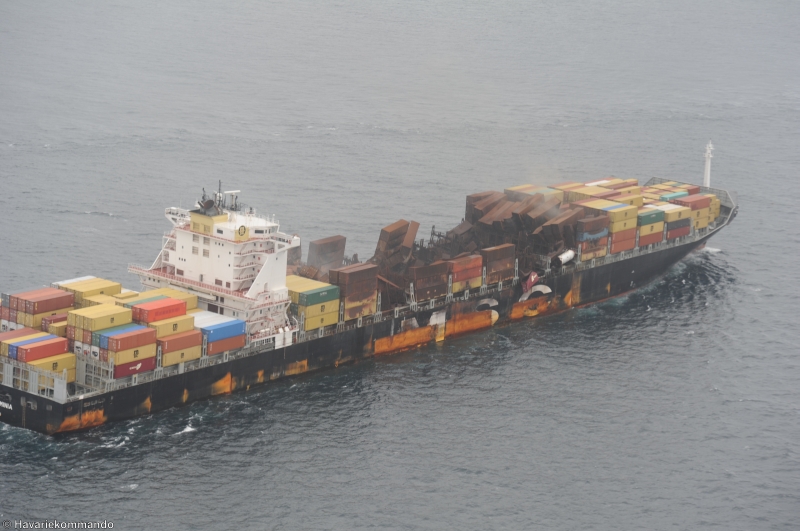
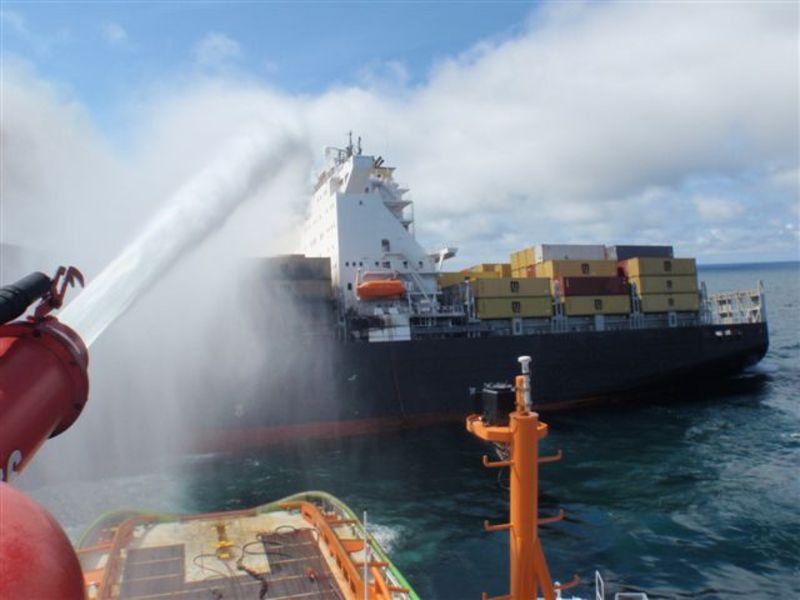
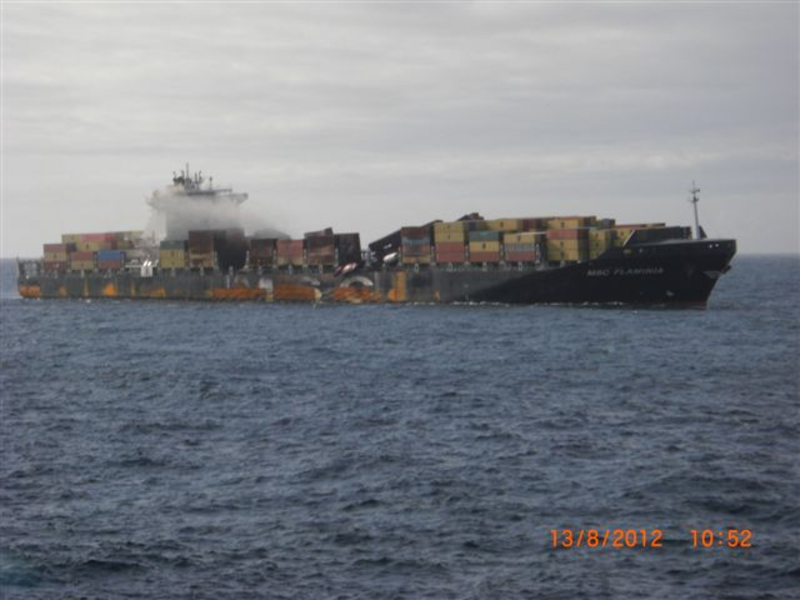

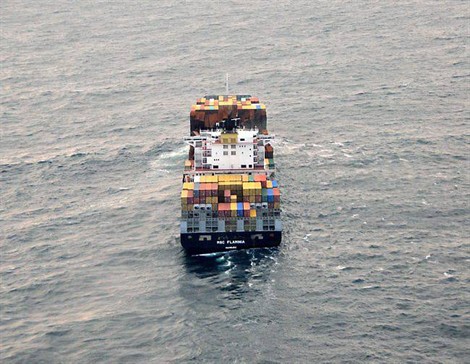


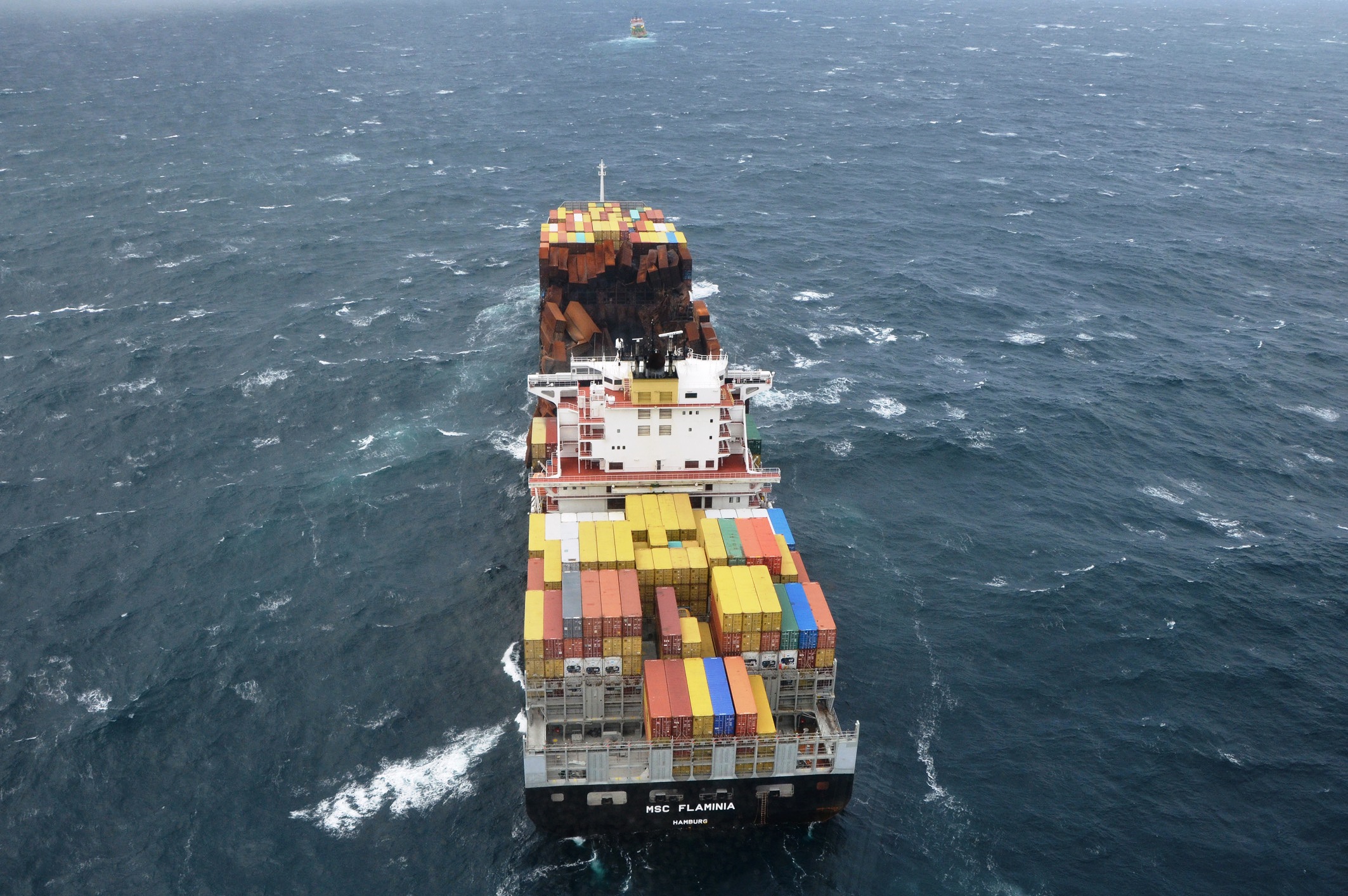
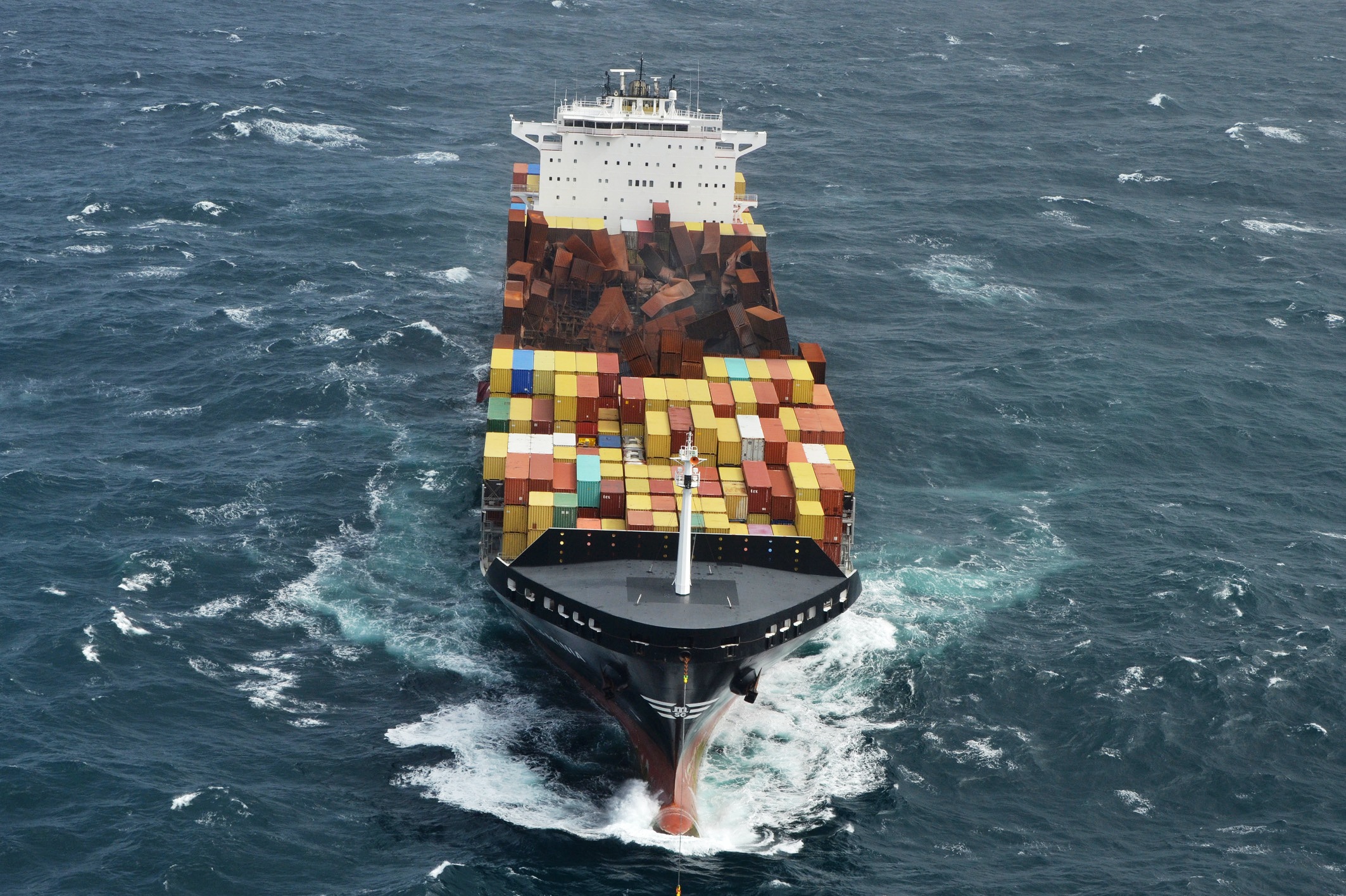
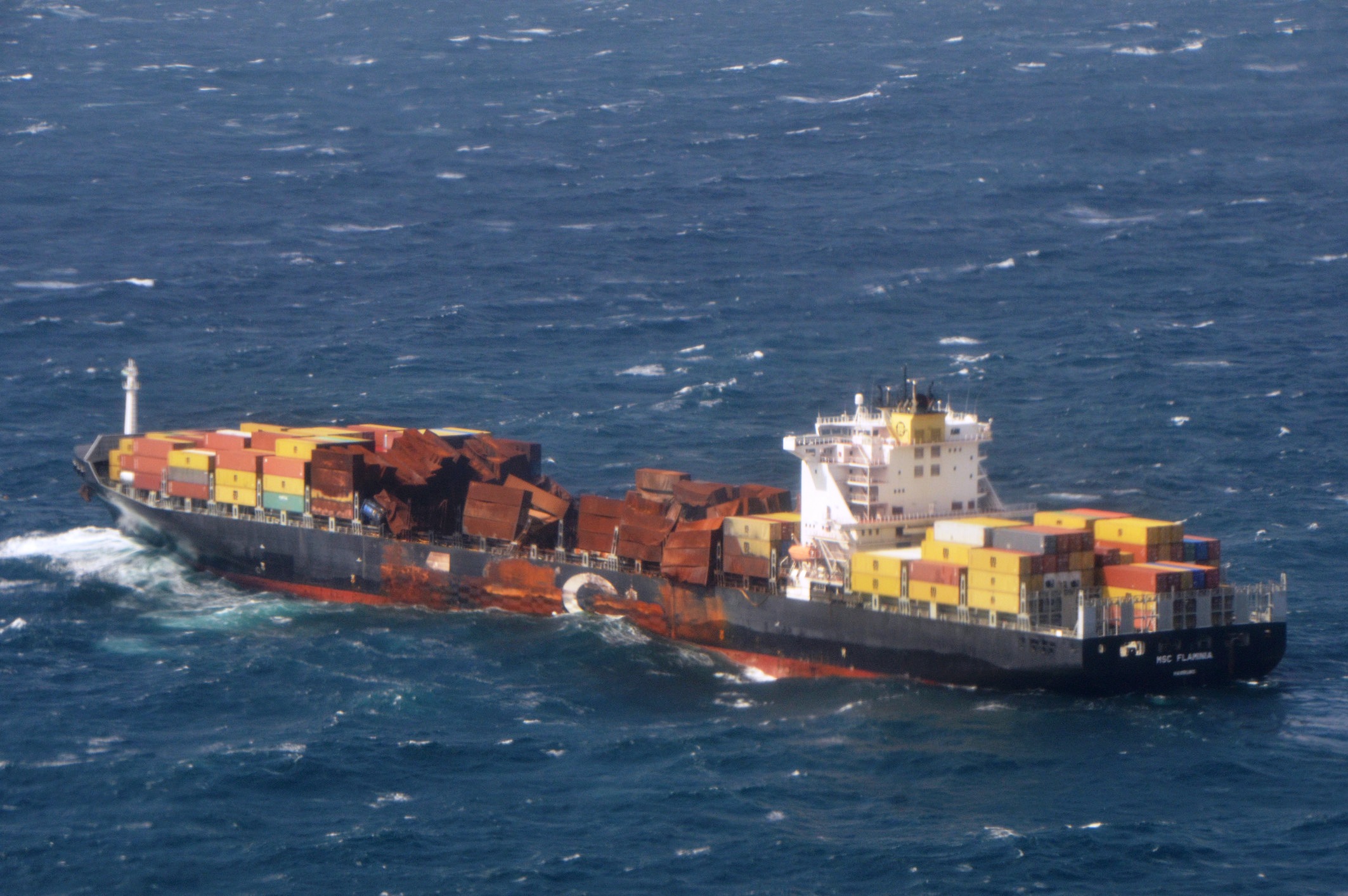
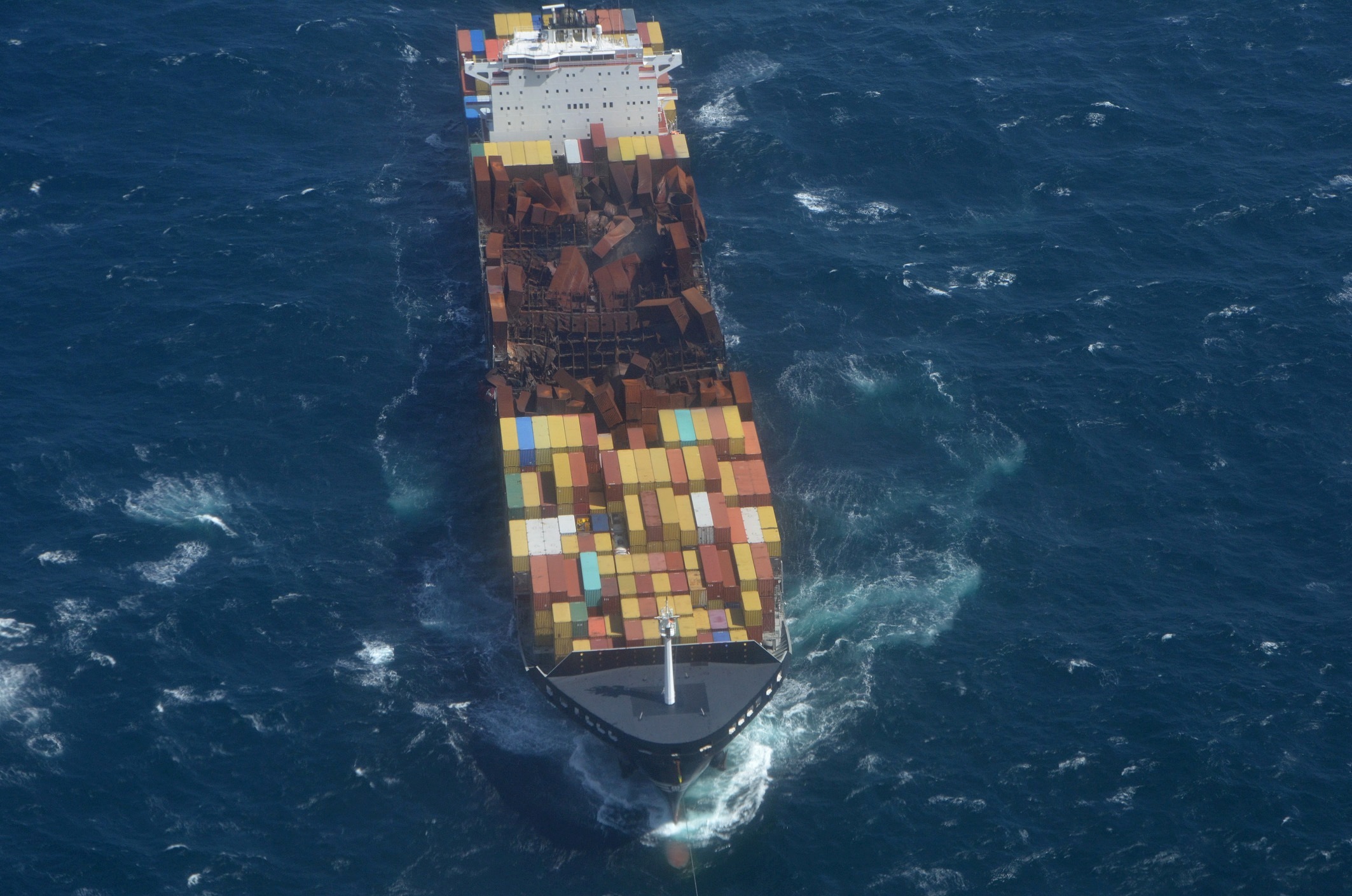
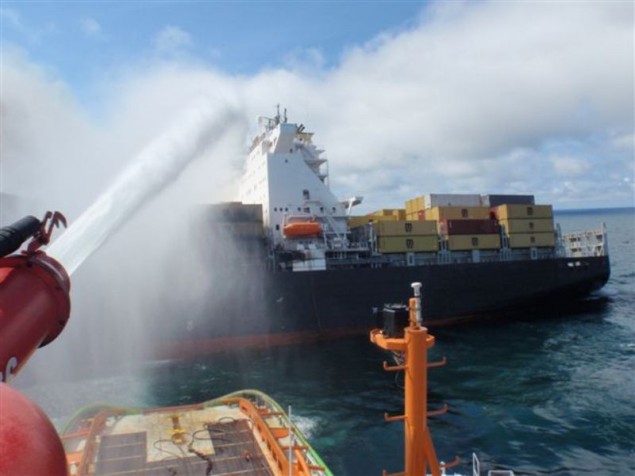


Story
Buxtehude, September 11 2012
After successfully concluding the salvage of MSC FLAMINIA, SMIT Salvage handed over the vessel to Reederei NSB in Wilhelmshaven on Monday. Reederei NSB would like to express its acknowledgement and gratitude towards the salvage captains and their crews as well as towards the owners of the salvage tugboats FAIRMOUNT EXPEDITION (Fairmount Marine), ANGLIAN SOVEREIGN (L. P. Knight) und CARLO MAGNO (Augustea S.A.) for their professional work under the given circumstances.
The costs for the salvage of MSC FLAMINIA, the disposal of her cargo and the extinguishing water as well as for the ensuing repair of the vessel can currently not be estimated. They will, however, be defrayed by the insurances as part of the general average which has been declared.
After a further inspection by the Fact Finding Team of the GCCME on Monday, the surveyors of TUIS (Transport-Accident-Information- and Emergency-Response System) confirmed that MSC FLAMINIA does not present an imminent chemical danger.
On Tuesday, Police, state attorneys and BSU (Federal Bureau of Maritime Casualty Investigation) will initiate their investigations onboard of MSC FLAMINIA. The search for the missing seafarer and preliminary investigations into the cause of the fire are the main priorities at this stage. Subsequently during this week, a team of experts for forensic investigations into causes of fires will inspect MSC FLAMINIA on behalf of Reederei NSB.
Reederei NSB currently awaits the approval of the authorities to start the unloading and cleanup of MSC FLAMINIA. The restoration of onboard systems and the superstructure will then also be initiated.
Buxtehude, September 09 2012
MSC FLAMINIA and its accompanying vessels have arrived safely today at 05.30 P.M. at Jade Weser Port in Wilhelmshaven. The arrival at the port was without any exceptional occurrences.
On Saturday, MSC FLAMINIA had reached its anchorage area off of Heligoland. There, the vessel was again inspected. During this inspection it was confirmed that a secure and hazard-free continuation of its voyage to Wilhelmshaven was possible. MSC FLAMINIA left the anchorage area around 08.30 A.M. towards Jade Weser Port.
The search for the still missing crewmember and the investigations into the cause of the fire will commence as soon as possible. These investigations will approximately last for one week. Afterwards, the unloading of the vessel can be started.
Buxtehude, September 07 2012
MSC FLAMINIA and its accompanying group of tugs will reach the anchoring area off Heligoland on Saturday. There, the Fact Finding Team of the German Central Commando for Maritime Emergencies will go onboard and conduct an additional inspection. Depending on the result of this inspection, the vessel will then go alongside the pier of Jade-Weser-Port in Wilhelmshaven on Sunday.
There, Reederei NSB and the GCCME will immediately commence the search for the missing seafarer. The investigation into the cause of the fire and any further assessment of the status of MSC FLAMINIA will take several days until the next steps can be initiated.
Buxtehude, September 05 2012
The passage of MSC FLAMINIA and its accompanying group of tugs through the English Channel continues. The vessel is expected to pass the border between French and Belgian territorial waters tonight. The transfer is proceeding without any exceptional events.
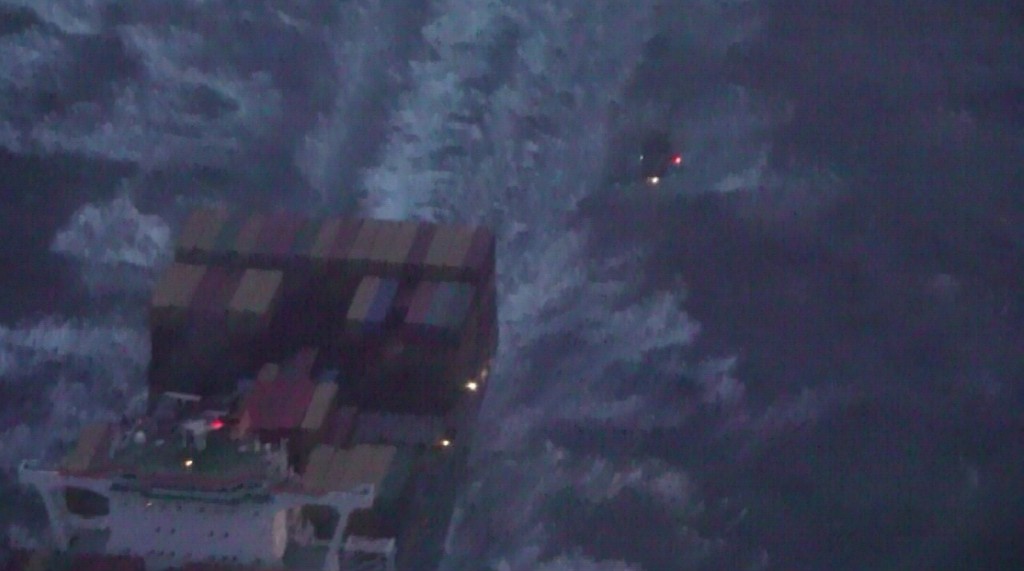
The pictures published together with this update were taken shortly before the commencement of the passage through the English Channel. They show MSC FLAMINIA with the towing gear connecting it to FAIRMOUNT EXPEDITION (Fairmount Marine). Additionally, it is apparent that there is no smoke generation.
The vessel is expected in German territorial waters this weekend.
Buxtehude, September 02 2012
MSC FLAMINIA and her accompanying tug boats have left her holding position 20 miles south of Lands End and is now being towed to German territorial waters. At 12.30 lt (UTC + 1 hr) tow connection had been handed over from CARLO MAGNO to FAIRMOUNT EXPEDITION. They will reach their first waypoint at 13.45 lt.
The passage of the English Channel is expected to take five days.
Buxtehude, September 01 2012
MSC FLAMINIA on Sunday on her way to German territorial waters
MSC FLAMINIA and her accompanying tug boats are expected to start passage of English Channel on Sunday. Passage will take approximately five days.
After all fires had been extinguished on board the MSC FLAMINIA by the salvage company Smit Salvage and after the stability and floatabilty as well as the solidity of the hull of MSC FLAMINIA had been confirmed once more by classification society GL Germanischer Lloyd, all involved coastal states of the English Channel (Great Britain, France, Belgium and the Netherlands) had granted permission for the passage on Friday respectively on Saturday. At the moment the firefighting tugs FAIRMOUNT EXPEDITION (Fairmount Marine), ANGLIAN SOVEREIGN (L. P. Knight) and CARLO MAGNO (Augustea S.A.) are being prepared for the passage, which is expected to start on Sunday.
On site represantatives of Reederei NSB in cooperation with the salvage company and the Central Command for Maritime Emergencies Germany (Havariekommando) have re-established the stearing gear and energy supply on board the MSC FLAMINIA. Superstructure of the vessel is intact and usable. Precautionary measures for a safe passage have been taken jointly. Engineers of managing owners NSB and the salvage company will be on board the MSC FLAMINIA during the passage of the English Channel in order to ensure a fire watch and the operational readiness of the fire extinguishing device of the vessel at any time.
In close cooperation of all involved parties the MSC FLAMINIA will be towed to German territorial waters considering all safety aspects and observing maximum possible preventive measures.
Buxtehude, August 31 2012
After evaluating the results of the team of experts, who had analyzed the condition of MSC FLAMINIA, the passage of the vessel through the English Channel is unobjectionable from a safety-related perspective. Currently, final permissions from some littoral states are still pending. These permissions are expected in the next few days.
Until these permissions are granted, the salvage company SMIT will take the necessary preparations to ensure a safe passage through the English Channel.
The result of the experts is further confirmed by a report from Germanischer Lloyd which is based on the most current data from August 30, 2012. According to this report, stability and firmness of MSC FLAMINIA are not compromised and it is safe to tow the vessel.
The situation onboard has further improved. Most recent measuring shows that temperatures in cargo hold 7 are at merely 60° Celsius. The salvage team members are not required to employ any specialized PPE while working onboard of MSC FLAMINIA.
The situation of the cargo and especially the dangerous goods is carefully analyzed and monitored by experts of the German Central Command for Maritime Emergencies and Reederei NSB. The prevention of harm to the population and the environment is the top priority during all further stages of the salvage.
Buxtehude, August 28 2012
After adverse weather conditions on Monday prevented the boarding the MSC FLAMINIA, two teams of experts were able to take this action today. One team consists of international experts while another has been sent by the German Central Command for Maritime Emergencies. The results of the inspection are expected in the coming days. After a positive result it is still planned to tow MSC FLAMINIA through the English Channel towards German waters. There, the ship will be anchoring before it is transferred to Jade-Weser-Port in Wilhelmshaven.
Like during the last weeks already, the contracted salvage experts of SMIT Salvage have again boarded the ship today, too. Since assuming responsibility for the salvage operation in mid-July, they have taken every opportunity to evaluate the situation on site and actively engage in firefighting and salvage operations. Their additional inspection revealed that the final container in cargo hold 3 with a hot spot was successfully extinguished by SMIT. The temperature within the cargo hold matches the ambient temperature. In cargo hold 7, ten containers were declared to be extinguished. Currently, higher temperatures are measured only in four more containers. Overall, significant progress has been made in the containment of the fire.
Buxtehude, August 24 2012
This afternoon, MSC FLAMINIA and its accompanying tug boats FAIRMOUNT EXPEDITION (Fairmount Marine) and ANGLIAN SOVEREIGN (L.P. Knight) have arrived on the southwestern coast of the UK. The planned safety inspection will be conducted as soon as weather conditions make possible a secure transfer of the experts onboard the vessel. So far, the transfer was not possible due to adverse weather.
Already on August 23, 2012, an oil monitoring airplane of the German Central Command for Maritime Emergencies has overflown MSC FLAMINIA. During this flyover it could be confirmed that no liquids are leaking out of the vessel.
The German Central Command for Maritime Emergencies and Reederei NSB continue to intensively work together to coordinate any further processes regarding MSC FLAMINIA's salvage. For any decision, reports and assessments of international firefighting and dangerous goods experts, specialists for maritime salvaging, engineers and ship builders are taken into consideration. Results of the fact-finding team with respect to stabillity of the vessel and hotspots in cargo holds 3 and 7 remain to be seen.
Buxtehude, August 23 2012
Condition of MSC FLAMINIA and dangerous goods onboard containerships
On Friday, respectively Saturday, a safety inspection by two teams of experts and an additional stability analysis conducted by Germanischer Lloyd, will assess the condition of MSC FLAMINIA. Based on the results of this inspection, a decision about the permission to pass the English Channel, one of the most frequented see lanes in the world, will be made.
Following the fire and subsequent explosion on July 14, 2012, MSC FLAMINIA is showing damages to her cargo holds. According to calculations of the GL so far, the condition of the ship is stable. The hull, superstructure, engine room as well as the stern section and the forecastle of MSC FLAMINIA are intact. No leakages can be detected and the ballast water tanks, into which parts of contaminated extinguishing water have been pumped, are not leaking. The cargo – including dangerous goods containers – is in a state which allows the passage through the English Channel and her transfer to coastal areas and eventually an emergency port. Such dangerous goods containers are transported regularly on containerships and off-loaded in ports. Radioactive materials are not onboard MSC FLAMINIA. At NSB, dangerous goods of classification no. 7 are excluded from the charter parties. Detailed stowage and loading plans have been presented to the salvage company and all involved authorities since the beginning of salvage measures in mid-July. The German Central Command for Maritime Emergencies, which is leading the salvage effort, also has access to these documents.
„Dangerous goods are carried on all modern containerships", Helmut Ponath, CEO of Reederei NSB explains. "Our ships carry up to 11.000 TEU and it is a normal that dangerous goods, for example chemicals for the German industry, are among them. Everyone should be aware of that."
With the expected local conditions in the English Channel and the North Sea MSC FLAMINIA is capable to be afloat. Given the numerous precautions taken by the experts of the German Central Command for Maritime Emergencies damages to the environment can be excluded. For the German Central Command for Maritime Emergencies and Reederei NSB, the protection of the environment is central to all further salvage efforts.
Buxtehude, August 23 2012
MSC FLAMINIA and its accompanying tug boats FAIRMOUNT EXPEDITION (Fairmount Marine) and ANGLIAN SOVEREIGN (L.P. Knight) is currently moving towards British territorial waters. On Friday, the group is expected 40 nm south of Land's End, the western tip of the UK. Once there, a team of experts consisting of dangerous goods specialists, chemists and salvage experts will conduct a safety inspection onboard the vessel. Together with experts from the UK, France and the Netherlands the condition of the vessel and its cargo will be reviewed to ensure a safe passage through the English Channel.
In consultation with the German Central Command for Maritime Emergencies, MSC FLAMINIA will be towed to deep water anchorage in the German Bight, approximately 12 nm west of Heligoland. After completion of all planned tasks there, the vessel will then be towed to the port of Wilhelmshaven.
Buxtehude, August 21 2012
MSC FLAMINIA will be towed to sheltered anchorage in the North Sea
Under the coordination of the German Central Command for Maritime Emergencies, MSC FLAMINIA will be towed to sheltered anchorage in German waters. Subsequently, the vessel will be transferred to a port. While anchoring, experts (firefighters, chemists and engineers) will determine which hazards might emanate from the vessel and its cargo. Only afterwards a decision to which port the vessel will be towed, can be made.
A first observation of vessel and cargo will be conducted by British, Dutch and French experts on behalf of the Maritime and Coastguard Agency once MSC FLAMINIA approaches the vicinity of the English Channel on the coming weekend.
"We are glad that after the assignment to the Central Command for Maritime Emergencies, the salvage of our MSC FLAMINIA is finally proceeding. To us this indicates that our company's philosophy is right and the German flag pays off", Helmut Ponath, CEO of Reederei NSB, said on a joint press conference in Bremerhaven.
MSC FLAMINIA and its accompanying group of tugs are currently located approximately 350 nautical miles off the entrance to the English Channel. MSC FLAMINIA is expected to reach a so-called sheltered area in German territorial waters in the week after the next. The German Central Command for Maritime Emergencies estimates that the complete salvage operation will take up to two months.
During the fire and subsequent explosion on July 14, 2012, which occurred during MSC FLAMINIA's passage from Charleston/USA to Bremerhaven (via Antwerp and Felixstowe), one seafarer had died and one is still missing. A third seafarer remains in critical condition and is treated in a specialty hospital for burn wounds. The crew had abandoned the burning vessel and was rescued by an oil tanker.
Buxtehude, August 20 2012
MSC FLAMINIA to enter German waters - Press conference on August 21, 2012
More than five weeks after the fire and the explosion onboard MSC FLAMINIA, a permission to enter German waters could be obtained in cooperation with the German Ministry of Transportation. This noon, the vessel has been assigned to the German Central Command for Maritime Emergencies in Cuxhaven for further coordination. (www.havariekommando.de)
Further details will be presented at a joint press conference of the Central Command for Maritime Emergencies and Reederei NSB. The press conference is scheduled for August 21, 2012, at 11.00 a.m., in Atlantic Hotel Sail City in Bremerhaven.
MSC FLAMINIA is currently situated approximately 450 nautical miles off the British coast. The vessel and its accompanying group of tugs are again approaching British territorial waters with the aim of a safety inspection upon arrival.
During the fire and subsequent explosion on July 14, 2012, which occurred during MSC FLAMINIA's passage from Charleston/USA to Bremerhaven, one seafarer had died and one is still missing. A third seafarer remains in critical condition and is treated in a specialty hospital for burn wounds. The crew had abandoned the burning vessel and was rescued by an oil tanker.
Press contact Reederei NSB
Bettina Wiebe
+49 (0)4161 – 64 51 12
uk@reederei-nsb.com
Press contact
Central Command for Maritime Emergencies
Dr. Ulrike Windhövel
+49 (0)4721 – 56 71 70
presse-hk@havariekommando.de
Press conference
Atlantic Hotel Sail City
Am Strom 1
27568 Bremerhaven
Buxtehude, August 15 2012
There is still no permission for MSC FLAMINIA to enter a sheltered area or a subsequent emergency port. Reederei NSB and the salvage company both remain in contact with all littoral states to acquire this permission.
At the same time, MSC FLAMINIA and its accompanying group of tugs have taken a position over 400 nautical miles west of the entrance of The English Channel to avoid bad weather and the expected swell. Since the coming days are projected to bring deteriorating weather conditions, the group has set a northwesterly course to an area where less swell is expected. Its speed is 4.5 knots.
A significant impairment of the stability of MSC FLAMINIA due the expected wave height cannot be excluded and is observed apprehensively.
In the meantime, Reederei NSB has declared general average for the vessel.
Buxtehude, August 14 2012
Due to the inconsistent weather conditions salvage operations onboard MSC FLAMINIA can not be conducted continuously at the moment. The position of MSC FLAMINIA remains unchanged and the vessel is listing at 2.5 degrees.
Negotiations regarding the permission to enter a sheltered coastal area or an emergency port are still without any result.
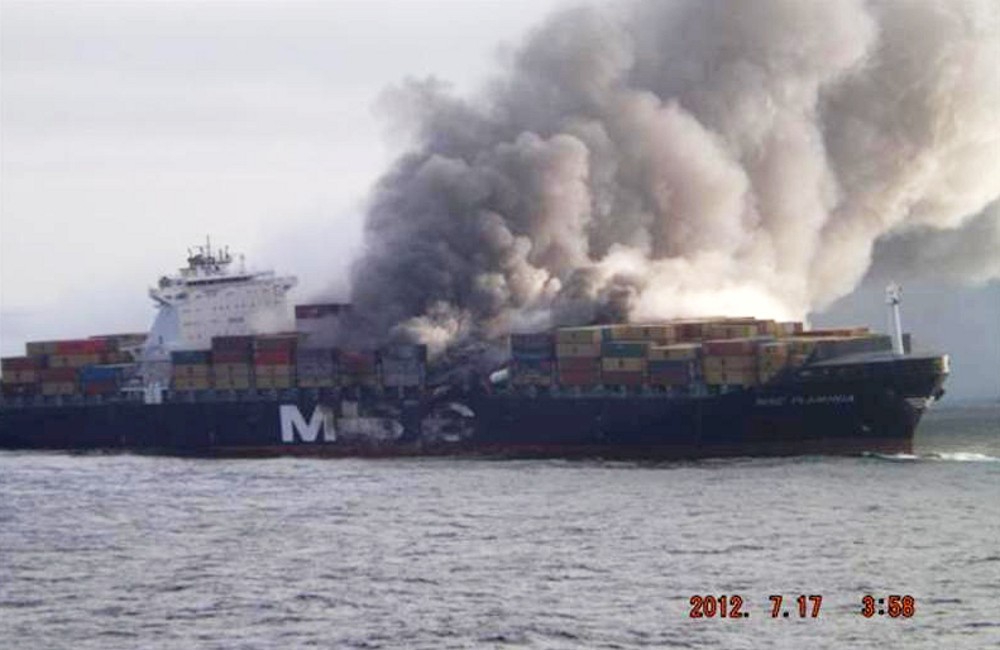
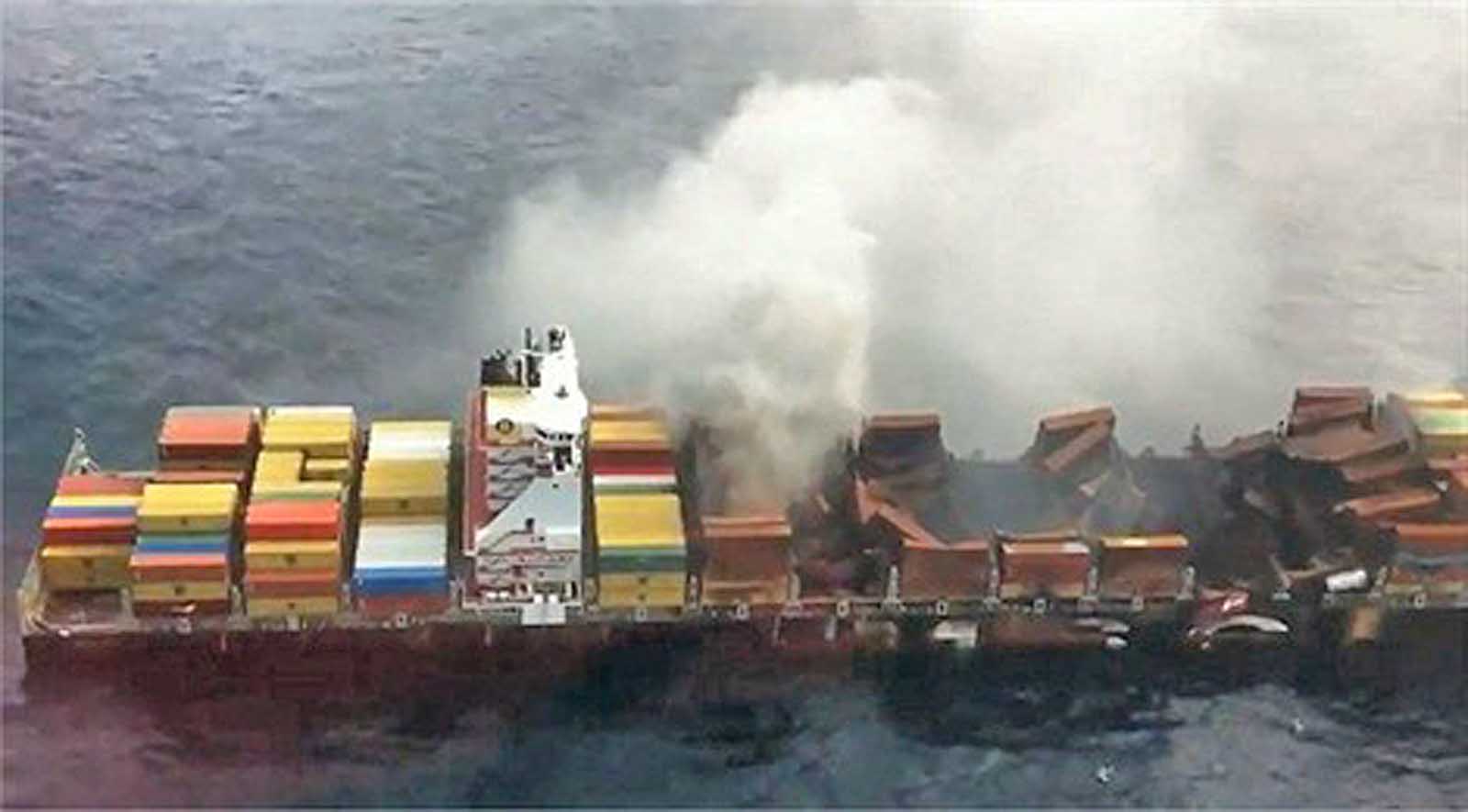
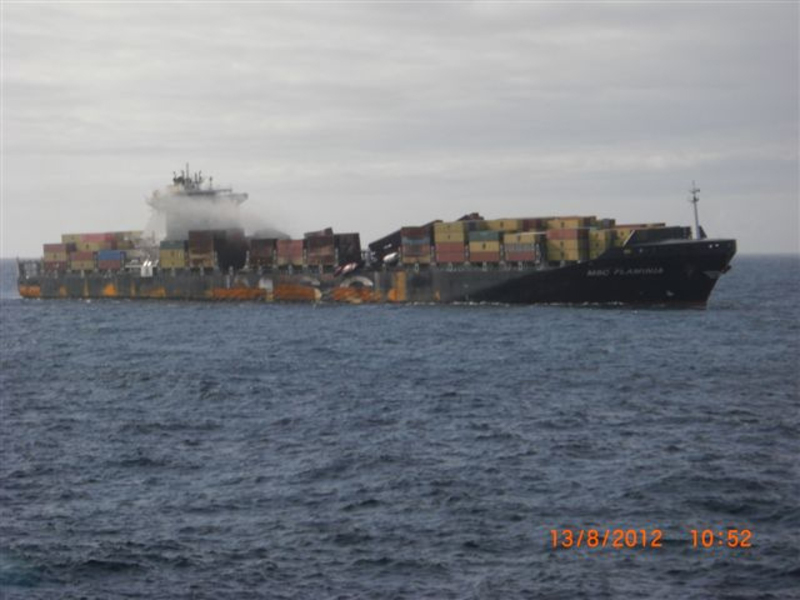
The image accompanying this statement, dated from the morning of August 13 2012, shows the damage to cargo holds 4, 5 and 6 as well as to the hull of MSC FLAMINIA. In addition, smoke emission in cargo hold 7 is discernable.
Buxtehude, August 13 2012
As weather conditions remained stable, firefighting experts onboard of MSC FLAMINIA continued to extinguish individual containers until yesterday evening. Currently, weather conditions worsened, forcing the suspension of the operations until the weather improves again.
During the past days the salvage team was able to stabilize the vessel by pumping water from the cargo holds into the ballast water tanks. By now, MSC FLAMINIA is listing by just 2.5 degrees. With this list, the vessel is stabilized to the extent that the entry into an emergency port is possible.
MSC FLAMINIA and its accompanying group of tugs are currently holding a waiting position approximately 240 nautical miles off the coast of the UK.
Despite ongoing talks with all involved authorities, a permission to enter a sheltered coastal area or an emergency port has not been granted yet.
Buxtehude, August 09 2012
The fire onboard MSC FLAMINIA remains under control. Individual hotspots still have to be fought. Thanks to stable weather conditions, salvage and firefighting operations can be continued. The vessel is listing by 10 degrees.
Since a permission to enter a coastal area is unfortunately still not granted, the position of MSC FLAMINIA remains unchanged. Without such a permission, which can only be given by European coastal states, the salvage of the vessel is not possible and the success of the operation is compromised. Helmut Ponath, CEO of Reederei NSB comments: "I consider it shocking that in this situation a ship under German flag does not receive a permission from the European countries to call at a port."
Currently, intense negotiations are conducted with all littoral states. NSB also remains in constant contact with German authorities in order to make use of all possibilities for continuing the salvage operation.
Buxtehude, August 06 2012
Thanks to improving weather conditions, a team of firefighting experts is able to board MSC FLAMINIA and continue the salvaging efforts today. Boarding had not been possible since July 30 2012. The current measures aim at inspecting areas which had not been accessible so far. Also, data is being collected to calculate and assess the stability of the vessel.
Smoke emission in cargo hold 7 has declined significantly. Temperatures in this area are also dropping again. Currently, no cooling by the accompanying tugboats is necessary. MSC FLAMINIA is still listing by approximately 10 degrees.
A decision to enter a sheltered coastal area has still not yet been made.
Buxtehude, August 03 2012
Situation on board the MSC FLAMINIA is unchanged. The team of firefighting experts has been unable to board the vessel since July 30th, 2012 due to bad weather conditions. A change of weather situation is predicted for Sunday this week.
A detailed statement regarding the condition of cargo hold 7 is only to be made when the salvage team can board the MSC FLAMINIA again. Temperatures are monitored continously in this area in order to carry on with boundary cooling. MSC FLAMINIA is still listing by approximately 10 degrees. Her waiting position is approximately 360 nautical miles off the British coast.
A decision to enter a sheltered coastal area has not yet been made but is expected in the coming days.
Buxtehude, July 31 2012
Since yesterday evening the team of firefighting experts is unable to go onboard MSC FLAMINIA due to bad weather conditions. In the coming days a further deterioration of the weather is predicted. Therefore, MSC FLAMINIA and the group of tugboats have pulled out of the 200 mile zone and maintain a position approximately 200 miles off the British coast.
According to the salvage team on site the fire in cargo holds 4, 5 and 6 has been extinguished. However, smoke is visible above cargo hold 7 and the temperatures in this area are rising. MSC FLAMINIA is still listing by 10 degrees.
A decision to enter a sheltered coastal area has not yet been made but is expected in the coming days.
Buxtehude, July 29 2012
MSC FLAMINIA and the accompanying group of tugboats have assumed a waiting position approximately 100 nautical miles off the British coast. While the team of firefighting experts is onboard MSC FLAMINIA, the vessel is not towed.
Today, a team of firefighting experts has again boarded MSC FLAMINIA. It is yet unsure when a one-by-one inspection of containers can commence. This inspection aims at eliminating any smoldering fires inside of containers. Firefighting and shipbuilding experts on site are among other things assessing the stability of the vessel.
Overall, the situation onboard MSC FLAMINIA continues to improve. According to firefighting experts, almost no smoke generation can be observed from cargo holds 4 and 5. Nevertheless, hotspots inside of individual containers should still be reckoned with.
A permission to enter a sheltered coastal area will be decided upon by authorities in the coming days.
Once the vessel has arrived at a so-called "sheltered area", a secure sea area close to the shore, further, more thorough investigations can be continued.
Buxtehude, July 26 2012
MSC FLAMINIA and its accompanying group of tugs is currently located 170 nautical miles off the coast of the UK and progresses at a speed of four knots. Due to damaged cargo and extinguishing water, the vessel is listing by 11 degrees.
After the prevailing fog of the last days lifted, a team of firefighting experts was able to board MSC FLAMINIA yesterday. However, a closer inspection of the cargo holds was not possible due to the ongoing generation of heat. The ship's own firefighting system was switched off.
Overall, the situation onboard MSC FLAMINIA has improved. The emission of smoke from cargo holds 4 and 5 has declined significantly. Nevertheless, hotspots inside of individual containers should still be reckoned with.
Today a team of firefighting experts will again go onboard MSC FLAMINIA. It is yet unsure when a one-by-one inspection of containers can commence. This inspection aims at eliminating any smouldering fires inside of containers.
A permission to enter a sheltered coastal area will be decided upon by British authorities in the coming days.
Buxtehude, July 24 2012
According to salvage experts on site, the fire onboard MSC FLAMINIA is under control since yesterday afternoon. The tugboat ANGLIAN SOVEREIGN is constantly monitoring temperatures onboard the vessel via a laser thermometer and is ready to resume cooling if necessary.
Due to thick fog the salvage team is currently unable to board MSC FLAMINIA. As soon as visibility improves, a salvage team will go onboard to check each container individually and extinguish any discovered fires. Only after this procedure MSC FLAMINIA will receive the permission to make a port call. It is currently not concluded which port the vessel will call next as this is still under review.
MSC FLAMINIA is still towed by FAIRMOUNT EXPEDITION, with ANGLIAN SOVEREIGN und CARLO MAGNO on standby. The group sails at a speed of 5kn towards Europe and is currently situated 320 nautical miles off the coast of the UK.
The vessel still lists by approximately 10 degrees due to damaged cargo and extinguishing water.
Buxtehude, July 23 2012
On Friday evening, firefighting tugboat FAIRMOUNT EXPEDITION (Fairmount Marine) has begun to tow MSC FLAMINIA toward Europe. Simultaneously, firefighting tugboat ANGLIAN SOVEREIGN (L.P. Knight) continues to cool the fire. The tugboat CARLO MAGNO (Augustea S.A.) accompanies the group on standby.
MSC FLAMINIA's own firefighting system is especially cooling the area in front of the superstructure.
Due to the extinguishing water and damaged cargo, MSC FLAMINIA is listing by 10 degrees.
Buxtehude, July 20 2012
As the firefighting operations at MSC FLAMINIA continue, the second firefighting tugboat ANGLIAN SOVEREIGN arrived this morning at the site of the incident. The third, CARLO MAGNO, is expected on site Saturday noon.
After the arrival of the second firefighting tugboat, a party of four salvage specialists has boarded MSC FLAMINIA. The team was able to reactivate the ship's own fire fighting system. It is now additionally supporting the firefighting operations of both tugboats.
Due to damaged cargo and extinguishing water the ship is listing by 8.5 degrees.
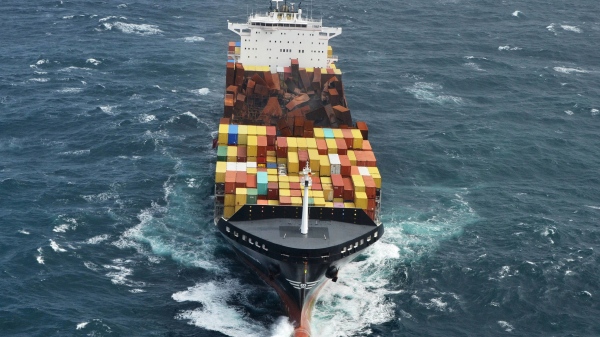
The extent of the damage onboard our MSC FLAMINIA is considerable. Cargo holds 4 - where the fire originated from -, 5 and 6 are demolished. According to salvage specialists cargo hold 7, which is located adjacent to the superstructure, is not on fire. The superstructure itself, the engine room as well as bow and stern – including the steering gear – are all not affected by the fire.
Buxtehude, July 19 2012 ( II )
Firefighting operations at the MSC FLAMINIA were resumed yesterday afternoon. Thanks to continuous cooling a further expansion of the fire could be prevented. It can be observed that superstructure, engine room, the stern section and the forecastle of the ship have all not been affected by the second explosion. According to the salvage captain the hull of the vessel is intact. Due to damaged cargo and extinguishing water a list of approximately 8-10 degrees has occurred. The second tugboat ANGLIAN SOVEREIGN is expected this evening. The third tugboat will reach the site of the incident on Saturday at noon. Salvage experts currently plan to board MSC FLAMINIA via the deployed emergency ladder and reactivate the firefighting systems. Experts estimate that the firefighting operations could take some weeks. Afterwards, MSC FLAMINIA is supposed to be towed to Europe for repairs.
Buxtehude, July 19 2012
18 crew and two passengers from the containership MSC FLAMINIA arrived safely at Falmouth/UK, onboard the oil tanker DS DRWON late yesterday evening. They were rescued after a fire had broken out onboard MSC FLAMINIA on July 14, 2012.
Crew and passengers were received by a team of Reederei NSB. They are unharmed and well given the circumstances. On completing all formalities and receiving aid and support during a rest period, they will spend the night at a hotel. They will begin repatriation, with the aim of rejoining their families as soon as possible.
Reederei NSB would like to thank the captain and crew of DS CROWN for the rescue and provision of aid to the crew and passengers of MSC FLAMINIA. During this dramatic rescue, they have shown extraordinary dedication and proven their excellent nautical skills.
Buxtehude, July 18 2012
The firefighting operations at MSC FLAMINIA, which had been started yesterday at 11.00 am lt, had to be aborted again during the last night, after a second explosion erupted in bay 47 of the vessel. To ensure the safety of the crew of the firefighting tugboat and of our second engineer onboard, the vessel had to assume a stand by position approximately one nautical mile off of the MSC FLAMINIA.
After the evaluation of the situation on site by our experts, the danger of continuing the firefighting operations was too high due to dangerous goods which are onboard.
A team of firefighting experts and the emergency team of NSB are checking the further proceedings. The tugboat is supposed to resume the firefighting operations soon.
The second firefighting tugboat ANGLIAN SOVEREIGN is expected to arrive on the site of the incident at midnight lt on July 19. In addition, a third tugboat was ordered to the site. Tugboat CARLO MAGNO is now on her way from Rotterdam to our MSC FLAMINIA. It is currently planned to hold MSC FLAMINIA's position with one tugboat while the two others proceed with the firefighting operations.
We will inform at this place as soon as new information becomes available.
Buxtehude, July 17 2012 (II)
The firefighting tugboat FAIRMOUNT EXPEDITION reached our MSC FLAMINIA today at 11.00 am. She arrived after our MS HANJIN OTTAWA had already reached the site of the incident in the early morning hours. Fire fighting operations were commenced immediately.
In addition to the fire fighting measures, HANJIN OTTAWA's second engineer was transferred to the tugboat. He will remain at the site to support the salvage team with his technical expertise and to accompany the ship's transport back to Europe. Our second engineer is tasked with reactivating the fire fighting systems on board MSC FLAMINIA to support the operations. With this action, the search for our still missing crewmember should resume as soon as possible. Meanwhile, HANJIN OTTAWA has continued her original voyage to the Suez Canal.
While continuing the fire fighting operations, the salvage captain is expected to give an initial assessment of the situation and condition of MSC FLAMINIA.
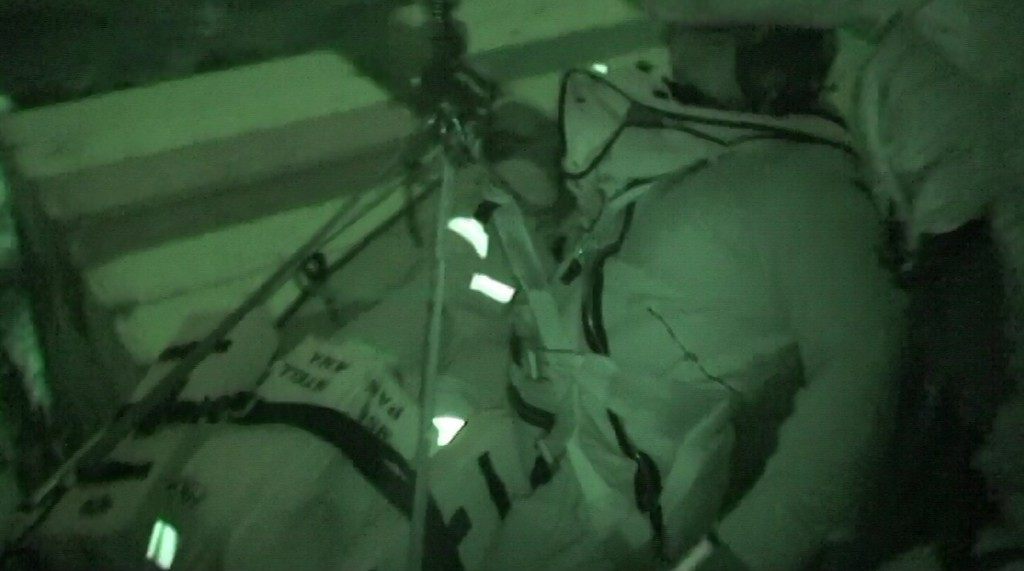
Referring to the pictures transmitted by HANJIN OTTAWA, the damage to the ship and its cargo cannot ultimately be estimated. It becomes clear, however, that neither superstructure, engine room, the stern section nor the forecastle of the ship are directly affected by the fire or the explosion.
Buxtehude, July 17, 2012
Thanks to the good medical care provided by Portuguese hospitals, we are relieved to report that our seafarers, which were injured during the incident onboard MSC FLAMINIA, are recovering well. Our heavily injured crewmember, who was transferred to a specialty hospital for burn wounds on Monday, made the transport well. The two crewmembers who are still being treated on the Azores will most probably be released at the end of this week to be repatriated.
On behalf of all employees, the management board of NSB would like to express again its condolences and its grief. "This tragedy onboard MSC FLAMINIA has deeply afflicted me. Our thoughts are with the families of the deceased and the missing sailor as well as with the recued and their families. We are in constant and close contact with the relatives of all our crewmembers and passengers", said Helmut Ponath, CEO of Reederei NSB.
The crewmembers that were rescued by DS CROWN are still on their way to Falmouth/UK. They are expected to arrive in the night between Wednesday and Thursday.
Our MS HANJIN OTTAWA has arrived on the site of the incident this morning. So far, the scale of the damage of MSC FLAMINIA could not be assessed due to the still prevalent darkness. MS HANJIN OTTAWA awaits the arrival of the tugboats FAIRMOUNT EXPEDITION and ANGLIAN SOVEREIGN and monitors the situation from a safe distance.
We will inform at this place as soon as new information becomes available. For further technical details about MSC FLAMINIA please scroll down.
Buxtehude, July 16, 2012
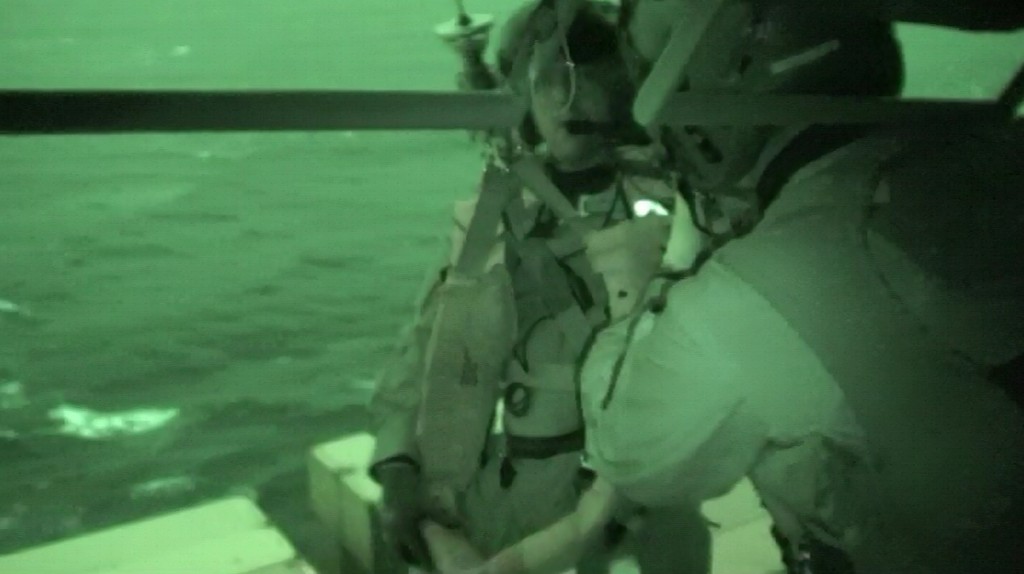
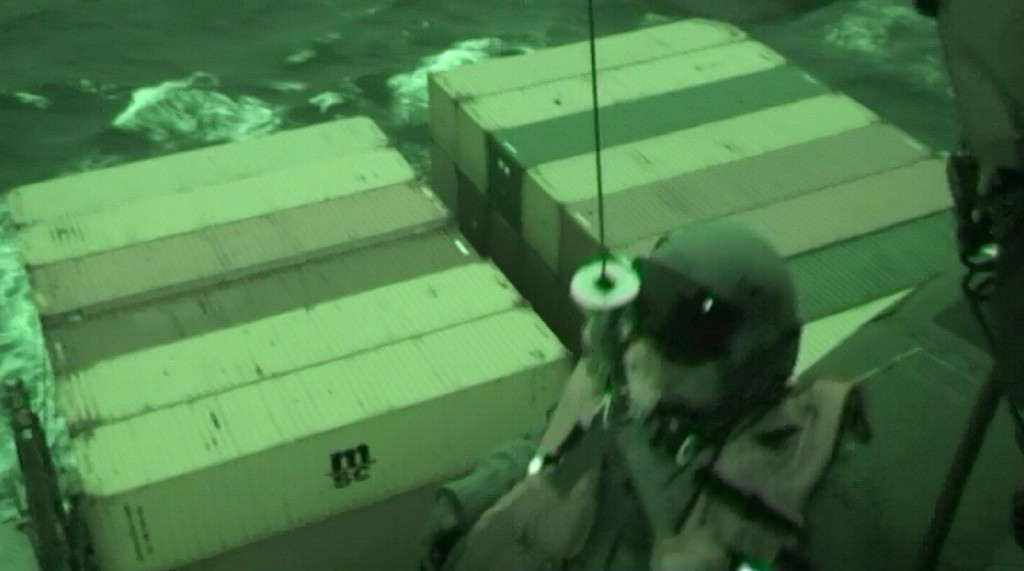
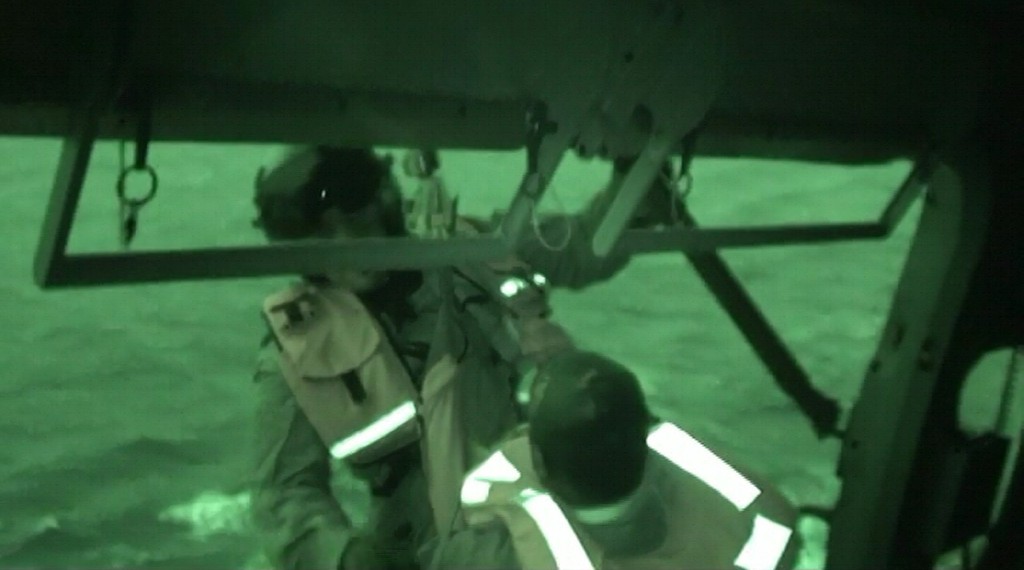
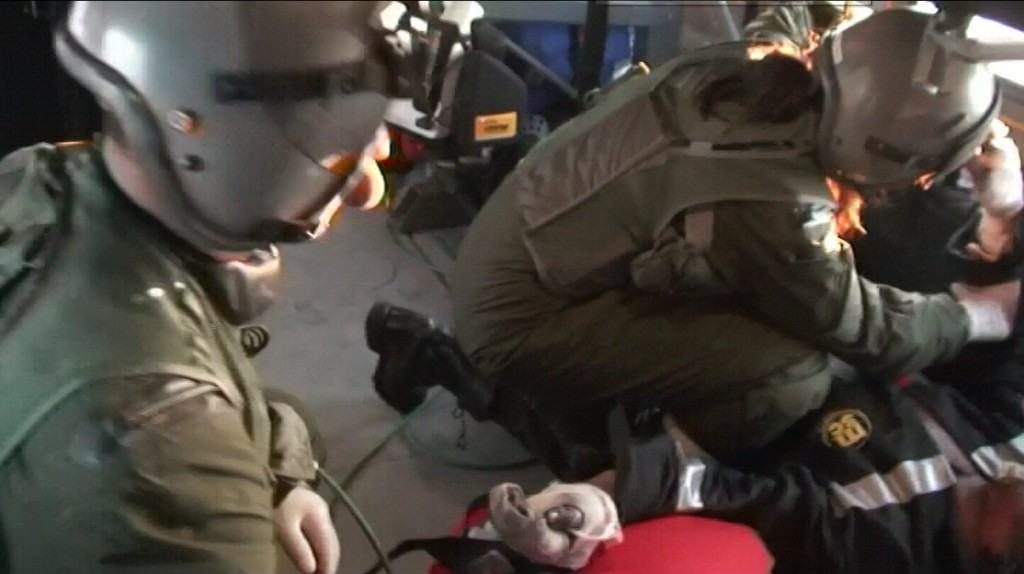
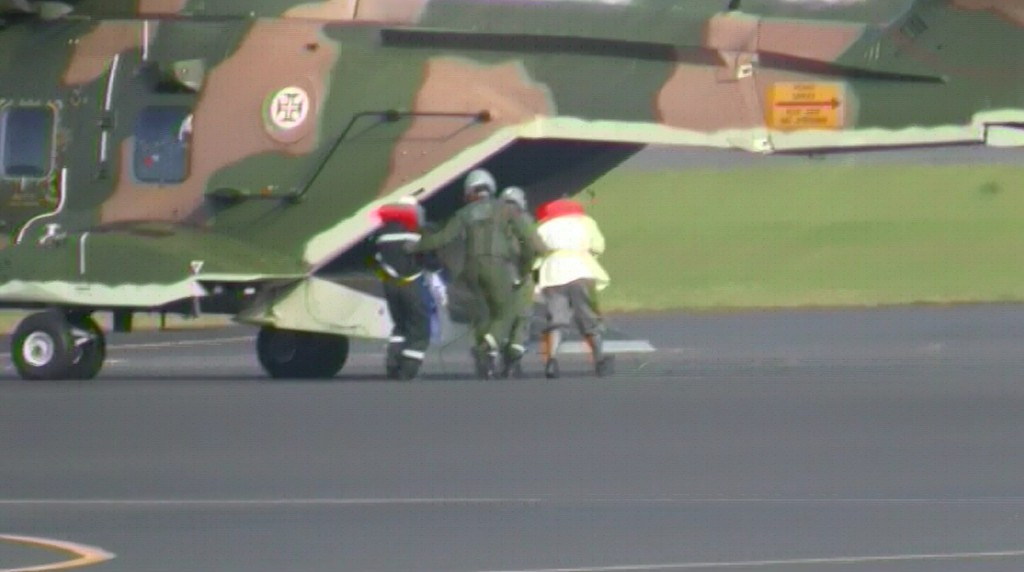
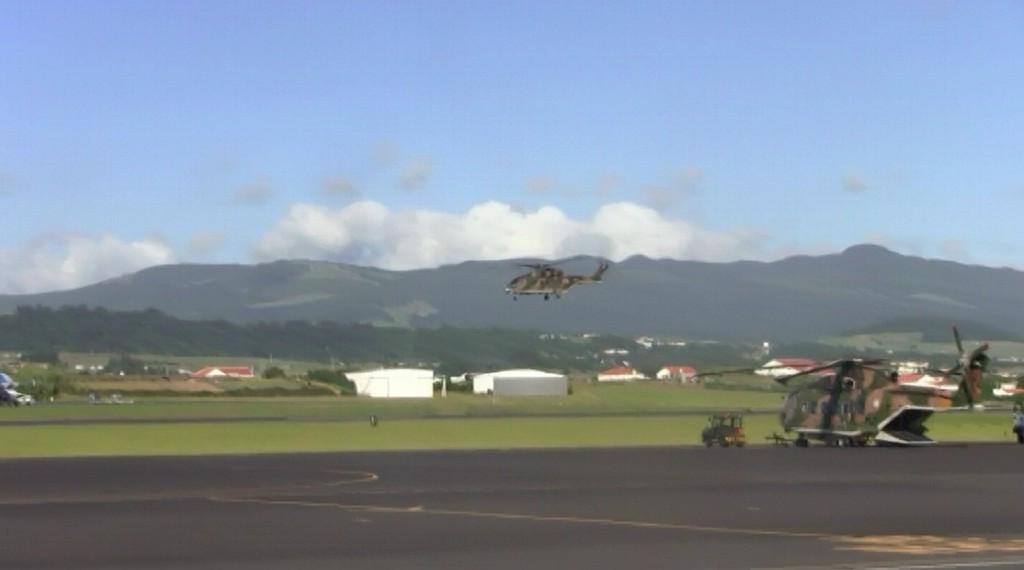
After the incident onboard MSC FLAMINIA on July 14, 2012, three injured seafarers were transferred to MSC STELLA and subsequently taken off by helicopter and flown to a hospital on the Azores. The latest report on their condition states that two are in stable condition and have been transferred to a general ward. The third man, however, has been transferred to a speciality hospital in mainland Portugal.
The remaining 18 crew members, together with two passengers, are onboard the oil tanker DS CROWN which is expected to arrive at the UK port of Falmouth during the evening of Wednesday, July 18. They will then be repatriated, to rejoin their families.
SMIT Salvage of Rotterdam, one of the world's leading marine salvors, is responding to the MSC FLAMINIA. Two large firefighting tugs have been despatched. The first, FAIRMOUNT EXPEDITION, will arrive in the area during the early evening of tomorrow, Tuesday, July 17. The second, ANGLIAN SOVEREIGN, will leave Inverness, Scotland, today (Monday, July 16) and is expected to arrive during late Thursday or early Friday. Additionally, a second ship of NSB's fleet has deviated to approach the site of the incident to support the salvage operations. Until the arrival of the salvage vessels, the cause of the incident and the condition of MSC FLAMINIA remains unresolved.
NSB is grateful for the efficient emergency response coordination provided by Falmouth Coastguard and the assistance provided by vessels which diverted to attend MSC FLAMINIA.
Further technical details about MSC FLAMINIA please scroll down.
Buxtehude, July 15, 2012
We regret to inform the public that one of our rescued seafarers of MSC FLAMINIA has passed away as a result of his wounds. A second seafarer is still missing.
Three injured crewmembers of MSC FLAMINIA were transferred already on July 14 to the vessel MSC STELLA which then proceeded to the Azores. An oncoming helicopter took over the injured personnel and flew them to a hospital on the Azores. One of the three injured persons remains in emergency care.
The remaining crewmembers are onboard the oil tanker DS CROWN and are on their way to Falmouth/UK.
An emergency team of Reederei NSB remains in close contact with the rescued crew as well as with their relatives.
Two fire-fighting tugboats are currently on their way to MSC FLAMINIA. At this moment, the cause of the fire is completely unresolved. NSB's emergency team is working together with all involved authorities to investigate the incident.
Currently, we do not have any new findings about the condition of the MSC FLAMINIA. An estimate of damages will only be possible after the arrival of the fire-fighting tugboats on scene on late Tuesday evening.
The priority of the emergency team of NSB at this moment is to care for best medical treatment for our injured crewmembers and for a safe return of the remaining personnel to their home countries.
Buxtehude, July 14, 2012
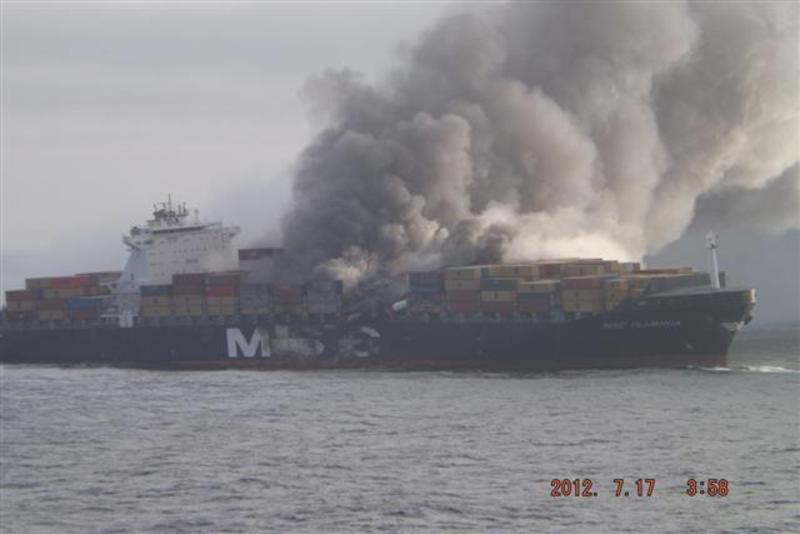
On July 14, 2012, a fire broke out onboard MSC Flaminia's cargo hatch no. 4. The ship was crossing the Atlantic Ocean on its way from America to Europe. While the crew was attempting to extinguish the fire, an explosion occurred.
The crew of MSC Flaminia is comprised of 23 men (five Germans, three Poles and 15 Philippine employees) and two passengers.
Nearby DS Crown was able to rescue 22 crew as well as the two passengers and has accommodated all persons.
One crew member is missing. Four crew members are injured, the rest of the crew as well as the passengers are unharmed.
Reederei NSB has immediately installed an emergency team and is in contact with the captain of DS Crown and MSC Flaminia, the UK Coast Guard, MRCC UK as well as Medico Cuxhaven.
MSC Stella, which is two hours apart, is on its way to the scene of the emergency. It will take over the injured seafarers.
We will share new information as soon as it is available at this place.
Costs
| 1 - Hull & Machinery |
USD 40 millions (sound value) |
2 - Cargo | USD 50 millions (fort the 1000 damaged containers) |
| 3 - Salvage | USD 0 | 4 - Costs | USD |
Liabilty Limits
| 1- LLMC 1976 | DTS XX | 2 -LLMC 1996 | DTS XX |
| 3 -CLC PROT 1992 | DTS XXX | 4 - CLC PROT 2000 | DTS XXXX |
| 5 - PAL 1974 | DTS XXX | 6 - PAL PROT 2000 | DTS XXX |
| 7 - BUNKER 2001 | SANS OBJET |
Cause of the casualty
Under investigation
Sources - Links - Reports
B
C
D
21 May 2012
COSTA CONCORDIA : Le plan de renflouement dévoilé ; Il coûtera au minimum 235 millions d'Euros
- Article Details
- Published on 21 May 2012
- Category Major cases
Le paquebot de croisière de 290 mètres de long avait chaviré le 13 janvier au large de l'île toscane du Giglio après avoir heurté des récifs. Une trentaine de personnes sont mortes, deux étant toujours portées disparues.
Costa Croisières, qui appartient au groupe Carnival Corp, a annoncé au cours d'une conférence de presse que le renflouement commencerait dans les jours qui viennent et durerait environ un an, pour un coût d'au moins 300 millions de dollars (235 millions d'euros).
Egalement présents, des représentants de l'américain Titan Salvage et de l'italien Micoperi, les deux entreprises sélectionnées pour mener le renflouement, se sont dit confiants quant au succès du plan.
"Ce sera le plus important renflouement de toute l'Histoire, mais nous pensons que c'est entièrement possible", a déclaré Richard Habib, président de Titan Salvage, qui appartient au groupe américain Crowley Maritime Corp.
Silvio Bartolotti, le directeur de Micoperi, a prédit que l'opération serait totalement bouclée d'ici février 2013.
Le navire sera ensuite remorqué jusqu'à un port italien et détruit. Le port toscan de Livourne pourrait être choisi de façon à indemniser la Toscane en créant des emplois, selon Enrico Rossi, le président de région.
Franco Gabrielli, le chef de la sécurité civile italienne, a annoncé que le navire serait stabilisé d'ici la fin août afin de l'empêcher de dériver dans les eaux profondes de la réserve marine où il se trouve.
Une catastrophe environnementale avait pu être évitée en mars, avec le retrait des eaux de 2.300 tonnes de carburant.
Francesco Schettino, le commandant du "Concordia", est accusé d'homicides involontaires, la justice italienne lui reprochant d'avoir amené le navire trop près des côtes et de l'avoir abandonné avant l'évacuation des 4.200 passagers et membres d'équipage. La Cour de Cassation Italienne vient d'ailleurs de le juger le 16 mai dernier inapte à commander un paquebot de croisière.
Dans son arrêt, la haute juridiction considère que le capitaine a fait preuve d'une "résistance insuffisante dans l'exercice de ses fonctions de commandement ou dans l'exercice de sa responsabilité à l'égard de la sécurité des personnes sous sa protection".
09 May 2012
COSTA CONCORDIA : Quelques nouvelles des procédures en cours....
- Article Details
- Published on 9 May 2012
- Category Major cases
.jpg) Après le temps du deuil, celui des indemnisations. Costa Crociere, la compagnie propriétaire du Costa Concordia, dont le naufrage le 13 janvier dernier a coûté la vie à 32 personnes, dont six Français, est aujourd'hui confrontée aux demandes de réparations de ces clients. Mercredi, quatorze naufragés français demanderont au juge des référés de Nanterre d'ordonner une expertise psychologique et le versement d'une provision de 50.000 euros chacun.
Après le temps du deuil, celui des indemnisations. Costa Crociere, la compagnie propriétaire du Costa Concordia, dont le naufrage le 13 janvier dernier a coûté la vie à 32 personnes, dont six Français, est aujourd'hui confrontée aux demandes de réparations de ces clients. Mercredi, quatorze naufragés français demanderont au juge des référés de Nanterre d'ordonner une expertise psychologique et le versement d'une provision de 50.000 euros chacun.
Ces 14 rescapés appartiennent à cinq familles françaises qui résident à la Réunion et en métropole. Ils ont refusé l'indemnisation de 11.000 euros proposée par Costa Crociere et réclament la nomination d'un expert pour évaluer leur préjudice psychologique.
En effet, s'ils n'ont pas subi de dommage corporel lors de l'accident, ils ont perdu leurs bagages et estiment important le trouble de stress post-traumatique consécutif au naufrage. "Certains ont essayé de reprendre le travail mais n'y sont pas parvenus. Des enfants font des cauchemars", souligne leur avocate Me Franchitto.
Mercredi dernier (2 mai 2012), l'avocat de la compagnie italienne compte pour sa part plaider l'incompétence du juge administratif de l'urgence des Hauts-de-Seine. "Le contrat de croisière est régi par le droit italien et donc un juge des référés français ne peut pas aller si loin dans le fond d'une affaire en appréciant le contenu d'une loi étrangère", estime Me Simon.
Le juge des référés de Nanterre a renvoyé mercredi au 20 juin l'examen de la demande de quatorze naufragés français du paquebot Concordia, qui réclament une expertise psychologique et une provision de 50.000 euros chacun, pour leur permettre de négocier avec Costa Croisières.
"Nous sommes actuellement en pourparlers avec la société Costa Croisières. Nous verrons si cette négociation aboutit ou n'aboutit pas", a affirmé leur avocate Me Laurie Franchitto à l'issue de l'audience.L'avocat de la compagnie italienne, Me Patrick Simon, n'a quant à lui pas souhaité faire de commentaire.
Le montant des indemnités réclamées est également une pierre d'achoppement entre les deux parties. Costa Crociere considère en effet le montant de la provision réclamée comme étant "hors de proportion". "Nous ne sommes pas aux Etats-Unis où l'on alloue des indemnités astronomiques", argue l'avocat de la compagnie. Pour Me Franchitto, la somme de 50.000 euros est au contraire "tout à fait raisonnable".
Depuis le naufrage quelque 180 familles françaises ont déjà accepté l'indemnisation de 11.000 euros proposée par la compagnie italienne, en échange de l'abandon de toute poursuite pénale ou civile et une vingtaine se sont joints à une class action aux Etats-Unis.
Les 235 restants, qui ont conclu un accord avec Costa Crociere le 17 avril, ont négocié une provision de 8.000 euros chacun, plus 1.000 euros de prise en charge de leurs frais de défense ou d'expertise. La compagnie a versé cette somme le 4 mai, pour un montant global de 2,115 millions, qui permettra à chacune de ces victimes d'être indemnisée à hauteur de 9.000 euros.
Les batailles judiciaires ne font que commencer, d'un coté comme de l'autre de l'Océan Atlantique....
05 May 2012
Jurisprudence Ilustrée : La Clause Himalaya ou Adler v. Dickson
- Article Details
- Published on 5 May 2012
- Category Court cases
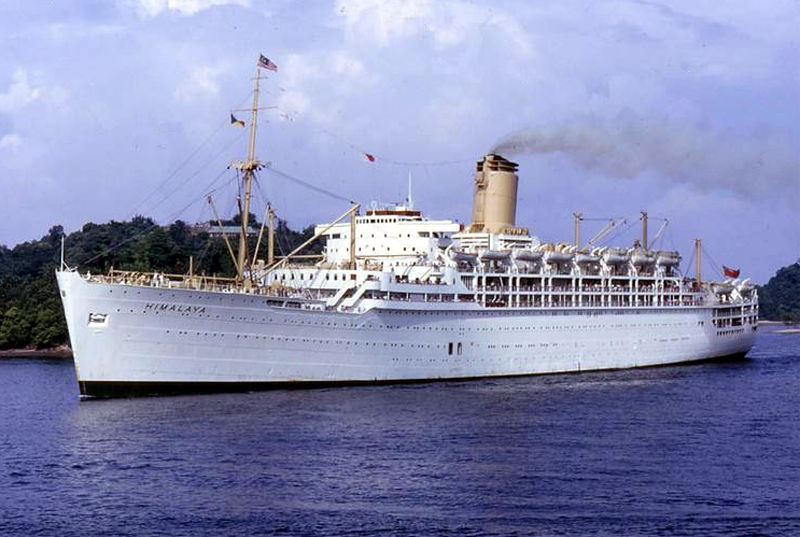
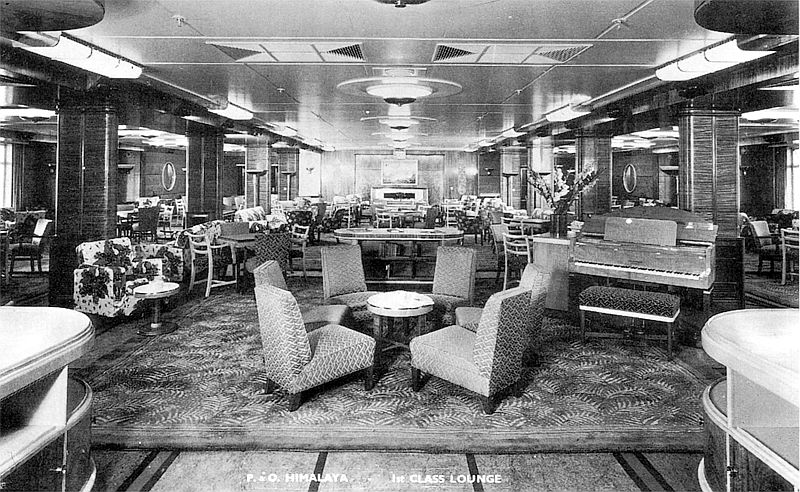
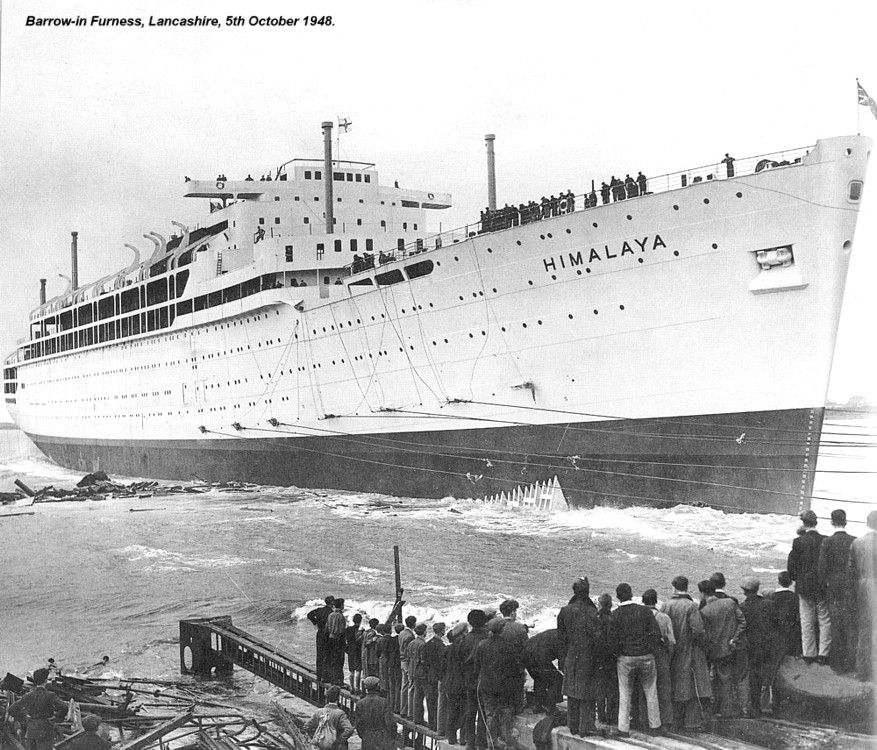
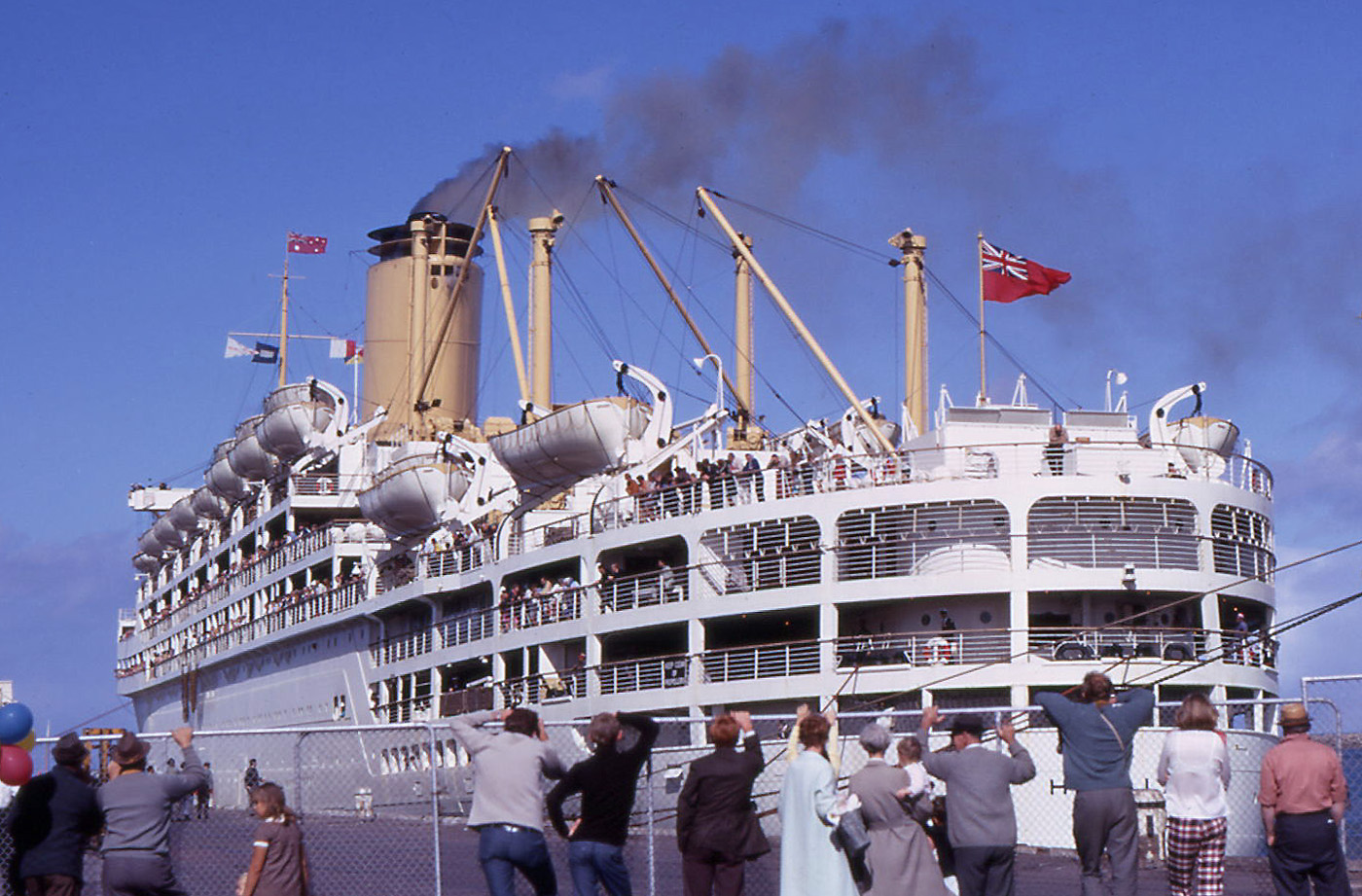
.jpg) Nous poursuivons notre série de "jurisprudence illustrée" avec un navire à passagers, le SS HIMALAYA et dont le cas donna naissance à la clause Himalaya et qui tire son nom de l'affaire anglaise Adler v Dickson. Mme Adler était un passager sur 'Himalaya', paquebot de la compagnie P & O et qui fût grièvement blessé lorsque la passerelle de débarquement sur laquelle elle avait pris place s'effondra, la projetant sur le quai. Le billet de passage contenait une clause d'exemption de non responsabilité au profit du transporteur P & O. Mme Adler poursuivit donc le capitaine du navire, Dickson, et le maître d'équipage afin d'être indemnisée de son préjudice. La Cour d'appel jugea le capitaine Dickson responsable et accorda des dommages à Mme Adler. La Cour décida cependant qu'il était possible pour P & O pour d'incorporer dans les conditions de vente de ses tickets de passage une clause lui permettant d'étendre à ses employés le bénéfice de sa clause de non responsabilité ; Cependant, ne l'ayant pas fait dans le cas du ticket de passage de Mme Adler, P&O et le capitaine Dickson ne pouvaient s'en prévaloir. Une conséquence de l'affaire «Himalaya» est que les clauses des contrats de transport (que ce soit pour les passagers ou de la cargaison) incluent au bénéfice des préposés du transporteur, les agents et sous-traitants, manutentionnaires, les exeptions ou limitations de responsabilité qui pourraient être avancées par le transporteur. La page consacrée à cette décision est ici.
Nous poursuivons notre série de "jurisprudence illustrée" avec un navire à passagers, le SS HIMALAYA et dont le cas donna naissance à la clause Himalaya et qui tire son nom de l'affaire anglaise Adler v Dickson. Mme Adler était un passager sur 'Himalaya', paquebot de la compagnie P & O et qui fût grièvement blessé lorsque la passerelle de débarquement sur laquelle elle avait pris place s'effondra, la projetant sur le quai. Le billet de passage contenait une clause d'exemption de non responsabilité au profit du transporteur P & O. Mme Adler poursuivit donc le capitaine du navire, Dickson, et le maître d'équipage afin d'être indemnisée de son préjudice. La Cour d'appel jugea le capitaine Dickson responsable et accorda des dommages à Mme Adler. La Cour décida cependant qu'il était possible pour P & O pour d'incorporer dans les conditions de vente de ses tickets de passage une clause lui permettant d'étendre à ses employés le bénéfice de sa clause de non responsabilité ; Cependant, ne l'ayant pas fait dans le cas du ticket de passage de Mme Adler, P&O et le capitaine Dickson ne pouvaient s'en prévaloir. Une conséquence de l'affaire «Himalaya» est que les clauses des contrats de transport (que ce soit pour les passagers ou de la cargaison) incluent au bénéfice des préposés du transporteur, les agents et sous-traitants, manutentionnaires, les exeptions ou limitations de responsabilité qui pourraient être avancées par le transporteur. La page consacrée à cette décision est ici.
02 May 2012
Nouvelle série : Les grands arrêts du Droit Maritime illustrés
- Article Details
- Published on 2 May 2012
- Category Court cases
 Après la série des "grandes fortunes du mer du passé" inaugurée il y a quelques jours avec la publication de notre fiche sur le TITANIC, voici une nouvelle série au sein de notre rubrique "Jurisprudence", les "grands arrêts du Droit Maritime" illustrés (ou impliquant un objet flottant !). En effet, au delà de l'arrêt ou de la décision de justice, il y a d'abord des faits, et des navires ou autres objets flottants pour ce qui concerne la matière de ce site....
Cette idée des "arrêts illustrés" ne vient pas de nous et a déjà été explorée, sur le web ou dans la "vraie vie", sur papier. Un livre paru en 2008 et intitulé Scènes de la jurisprudence administrative
30 April 2012
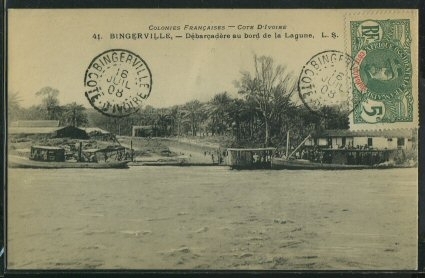
Société commerciale de l’Ouest africain - Bac d'Eloka
- Article Details
- Published on 30 April 2012
- Category Court cases
Le Tribunal des conflits considère que certains services publics fonctionnent dans les mêmes conditions qu'une entreprise privée et dégage la notion de service public industriel et commercial. Par suite, les litiges relatifs aux dommages causés par l'exploitation d'un service public et commercial relèvent de la compétence du juge judiciaire.
SOCIETE COMMERCIALE DE L'OUEST AFRICAIN - TRIBUNAL DES CONFLITS 22 Janvier 1921 - Bac d'ELOKA
DECISION
Tribunal des conflits
N° 00706
Publié au recueil Lebon
M. Pichat, rapporteur
M. Matter, commissaire du gouvernement
Lecture du 22 janvier 1921
REPUBLIQUE FRANCAISE
AU NOM DU PEUPLE FRANCAIS
Vu l'arrêté, en date du 13 octobre 1920, par lequel le lieutenant-gouverneur de la colonie de la Côte-d'Ivoire a élevé le conflit d'attributions dans l'instance pendante, devant le juge des référés du tribunal civil de Grand-Bassam, entre la Société commerciale de l'Ouest africain et la colonie de la Côte-d'Ivoire ; Vu l'ordonnance du 7 septembre 1840, le décret du 10 mars 1893, le décret du 18 octobre 1904 ; Vu les décrets des 5 août et 7 septembre 1881 ; Vu les lois des 16-24 août 1790 et 16 fructidor an III ; Vu l'ordonnance du 1er juin 1828 et la loi du 24 mai 1872 ;
Sur la régularité de l'arrêté de conflit : Considérant que si le lieutenant-gouverneur de la Côte-d'Ivoire a, par un télégramme du 2 octobre 1920, sans observer les formalités prévues par l'ordonnance du 1er juin 1828, déclaré élever le conflit, il a pris, le 13 octobre 1920, un arrêté satisfaisant aux prescriptions de l'article 9 de ladite ordonnance ; que cet arrêté a été déposé au greffe dans le délai légal ; qu'ainsi le tribunal des conflits est régulièrement saisi ;
Sur la compétence : Considérant que par exploit du 30 septembre 1920, la Société commerciale de l'Ouest africain, se fondant sur le préjudice qui lui aurait été causé par un accident survenu au bac d'Eloka, a assigné la colonie de la Côte-d'Ivoire devant le président du tribunal civil de Grand-Bassam, en audience des référés, à fin de nomination d'un expert pour examiner ce bac ;
Considérant, d'une part, que le bac d'Eloka ne constitue pas un ouvrage public ; d'autre part, qu'en effectuant, moyennant rémunération, les opérations de passage des piétons et des voitures d'une rive à l'autre de la lagune, la colonie de la Côte-d'Ivoire exploite un service de transport dans les mêmes conditions qu'un industriel ordinaire ; que, par suite, en l'absence d'un texte spécial attribuant compétence à la juridiction administrative, il n'appartient qu'à l'autorité judiciaire de connaître des conséquences dommageables de l'accident invoqué, que celui-ci ait eu pour cause, suivant les prétentions de la Société de l'Ouest africain, une faute commise dans l'exploitation ou un mauvais entretien du bac. Que, - si donc c'est à tort qu'au vu du déclinatoire adressé par le lieutenant-gouverneur, le président du tribunal ne s'est pas borné à statuer sur le déclinatoire, mais a, par la même ordonnance désigné un expert contrairement aux articles 7 et 8 de l'ordonnance du 1er juin 1828, - c'est à bon droit qu'il a retenu la connaissance du litige ;
DECIDE : Article 1er : L'arrêté de conflit ci-dessus visé, pris par le lieutenant-gouverneur de la Côte-d'Ivoire, le 13 octobre 1920, ensemble le télégramme susvisé du lieutenant-gouverneur n° 36 GP, du 2 octobre 1920, sont annulés.
ANALYSE (Conseil d'Etat)
Par la décision Société commerciale de l'Ouest africain, le Tribunal des conflits admet l'existence de services publics fonctionnant dans les mêmes conditions qu'une entreprise privée et donne naissance à la notion de service public industriel et commercial.
La société commerciale de l'Ouest africain était propriétaire de l'une des voitures qui furent gravement endommagées dans l'accident survenu au bac dit d'Eloka, service de liaison maritime situé sur la lagune du littoral de Côte d'Ivoire et exploité directement par la colonie. Aux fins de déterminer le juge compétent pour désigner l'expert dont la société demandait la nomination, le Tribunal des conflits a été amené à se prononcer sur la question de savoir si des services entiers de l'administration peuvent être regardés comme fonctionnant dans les mêmes conditions qu'une entreprise privée, auquel cas le juge compétent est le juge judiciaire.
Il était déjà admis que, pour certaines opérations isolées, l'administration pouvait agir comme un simple particulier sans user de prérogatives de puissance publique. L'admettre pour un service entier était plus délicat. Le Tribunal des conflits valida toutefois cette innovation et donna ainsi naissance, bien que le terme ne soit pas utilisé dans sa décision, à la notion de service public industriel et commercial.
C'est ainsi que des organes essentiellement administratifs, comme les collectivités publiques par exemple, peuvent exploiter de tels services : c'est le cas de l'État s'agissant du service des monnaies et médailles (CE, B..., 9 janvier 1981, n°226521, p. 4). A l'inverse, certains établissements auxquels la loi ou le décret les instituant a attribué un caractère industriel et commercial peuvent cependant exercer partiellement ou totalement des fonctions administratives. Tel est le cas par exemple de l'Office nationale des forêts (TC, 9 juin 1986, Commune de Kintzheim c/ Office national des forêts, p. 448).
Pour identifier un service public industriel et commercial, le juge, loin de s'en tenir aux qualifications parfois trompeuses des textes, à moins qu'ils ne soient de niveau législatif, met en oeuvre plusieurs critères dont les principaux sont l'objet du service, l'origine des ressources, les modalités du fonctionnement.
La qualification d'industriel et commercial donnée par la loi ou par le juge à un service entraîne en principe la compétence du juge judiciaire pour trancher les litiges le concernant. Mais cette compétence n'est pas générale : dans le domaine de la responsabilité en premier lieu, puisque le juge administratif se reconnaît compétent pour connaître des dommages de travaux publics causés à des tiers ainsi que des dommages causés par des services publics industriels et commerciaux dans l'exercice de prérogatives de puissance publique ; dans le domaine des contrats ensuite, puisque certains contrats relatifs à des services publics industriels et commerciaux, si le service est géré par une personne morale de droit public, peuvent avoir le caractère de contrat administratif si le second critère nécessaire à cette qualification est satisfait, ce second critère pouvant prendre plusieurs formes (contrat d'exécution de travaux publics, contrat d'occupation du domaine public, clauses exorbitantes du droit commun et enfin contrat confiant l'exécution même du service public). S'agissant du personnel enfin, les litiges les opposant au service relèvent toujours du juge judiciaire à l'exception du directeur et du comptable, s'il a la qualité de comptable public (Section, 8 mars 1957, J... de L..., n°15219, p. 158). Enfin, le juge administratif est compétent pour juger de la légalité des actes de portée générale des services publics industriels et commerciaux (TC, 15 janvier 1968, Compagnie Air France c/ Epoux Barbier, p. 789).
Tribunal des conflits - 22 janvier 1921- Société commerciale de l'Ouest africain - Rec. Lebon p. 91
SS HIMALAYA Court of Appeal 29 October 1954 ADLER V. DICKSON
- Article Details
- Published on 30 April 2012
- Category Court cases
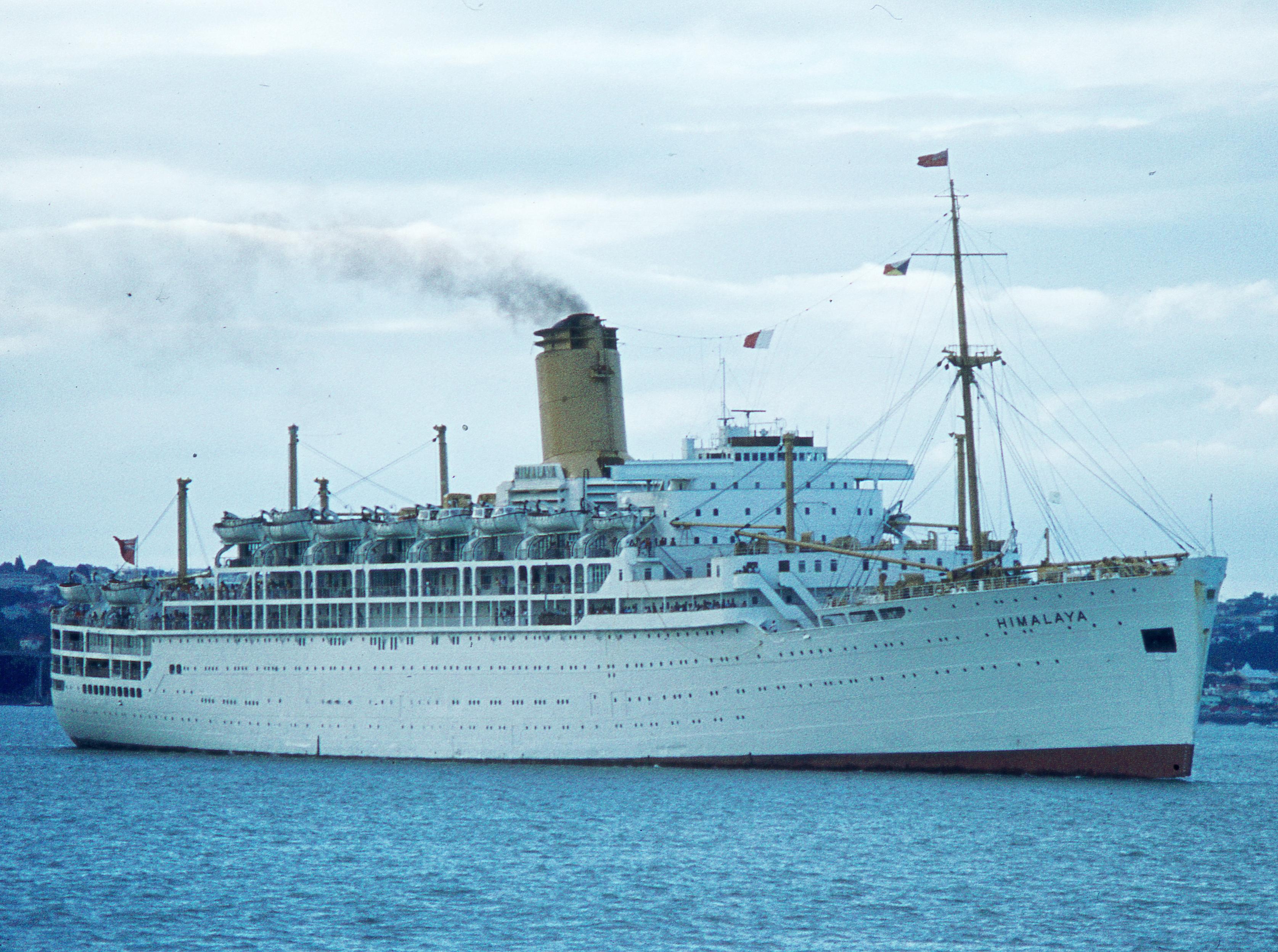
La clause Himalaya tire son nom de l'affaire anglaise Adler v Dickson. Mme Adler était un passager sur 'Himalaya', paquebot de la compagnie P & O et qui fût grièvement blessé lorsque la passerelle de débarquement sur laquelle elle avait pris place s'effondra, la projetant sur le quai. Le billet de passage contenait une clause d'exemption de non responsabilité au profit du transporteur P & O. Mme Adler poursuivit donc le capitaine du navire, Dickson, et le maître d'équipage afin d'être indemnisée de son préjudice. La Cour d'appel jugea le capitaine Dickson responsable et accorda des dommages à Mme Adler. La Cour décida cependant qu'il était possible pour P & O pour d'incorporer dans les conditions de vente de ses tickets de passage une clause lui permettant d'étendre à ses employés le bénéfice de sa clause de non responsabilité ; Cependant, ne l'ayant pas fait dans le cas du ticket de passage de Mme Adler, P&O et le capitaine Dickson ne pouvaient s'en prévaloir. Une conséquence de l'affaire «Himalaya» est que les clauses des contrats de transport (que ce soit pour les passagers ou de la cargaison) incluent au bénéfice des préposés du transporteur, les agents et sous-traitants, manutentionnaires, les exeptions ou limitations de responsabilité qui pourraient être avancées par le transporteur.
ADLER V DICKSON 29 OCTOBRE 1924 - English Court of Appeal - SS HIMALAYA
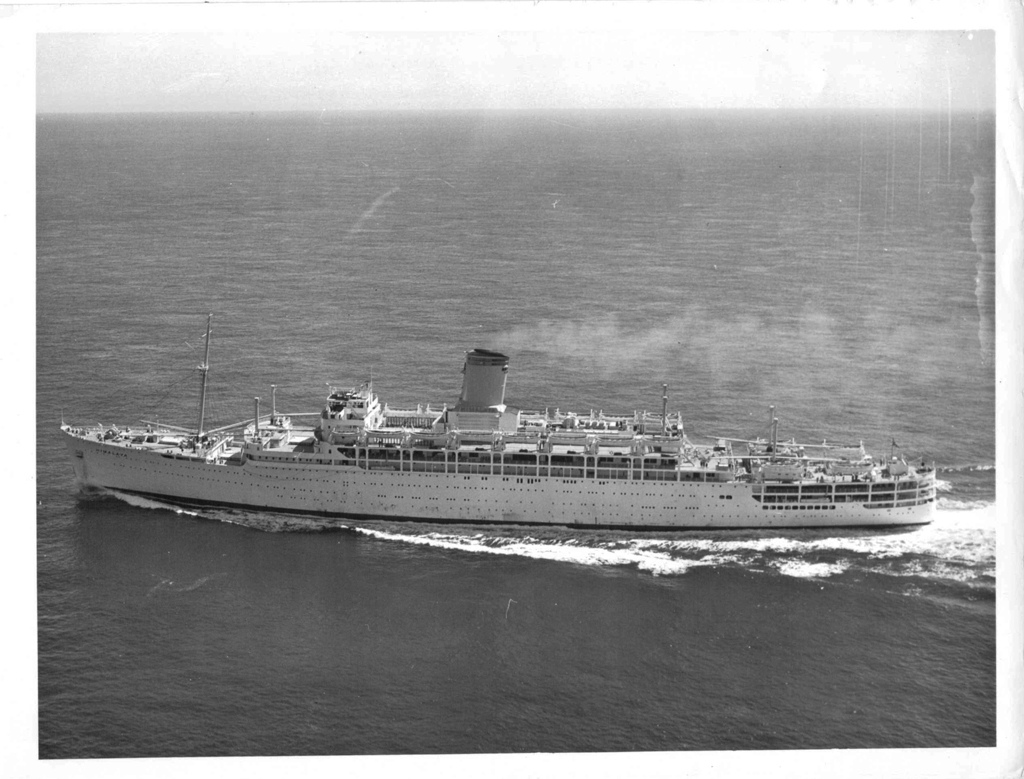
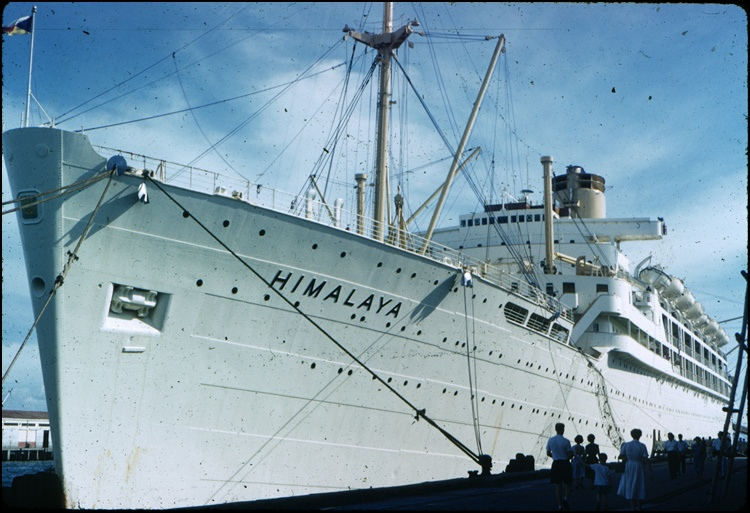
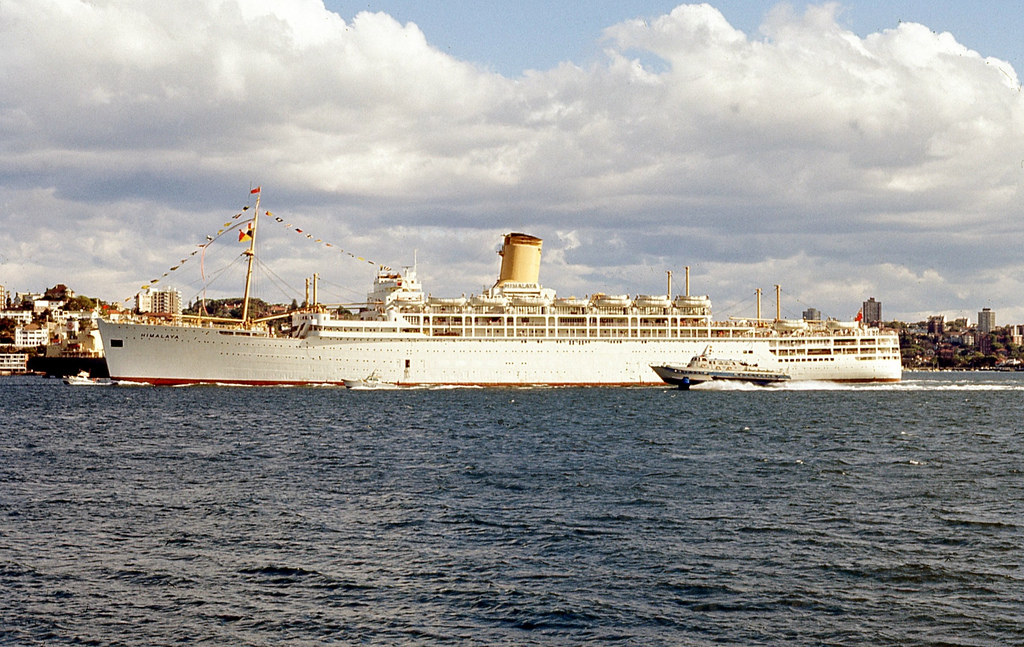
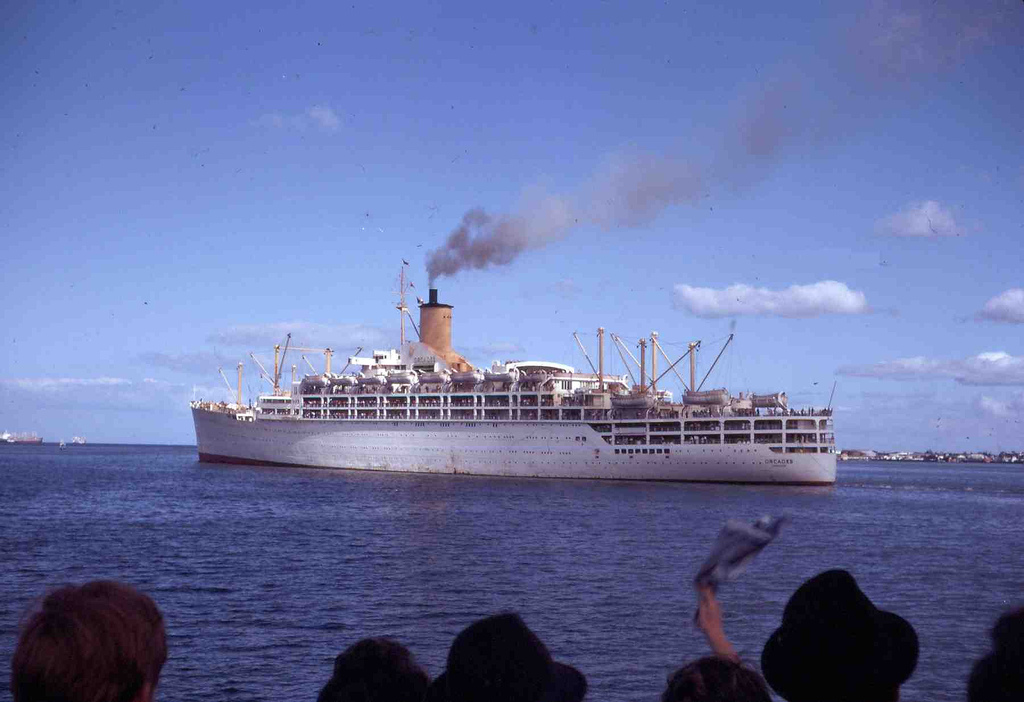
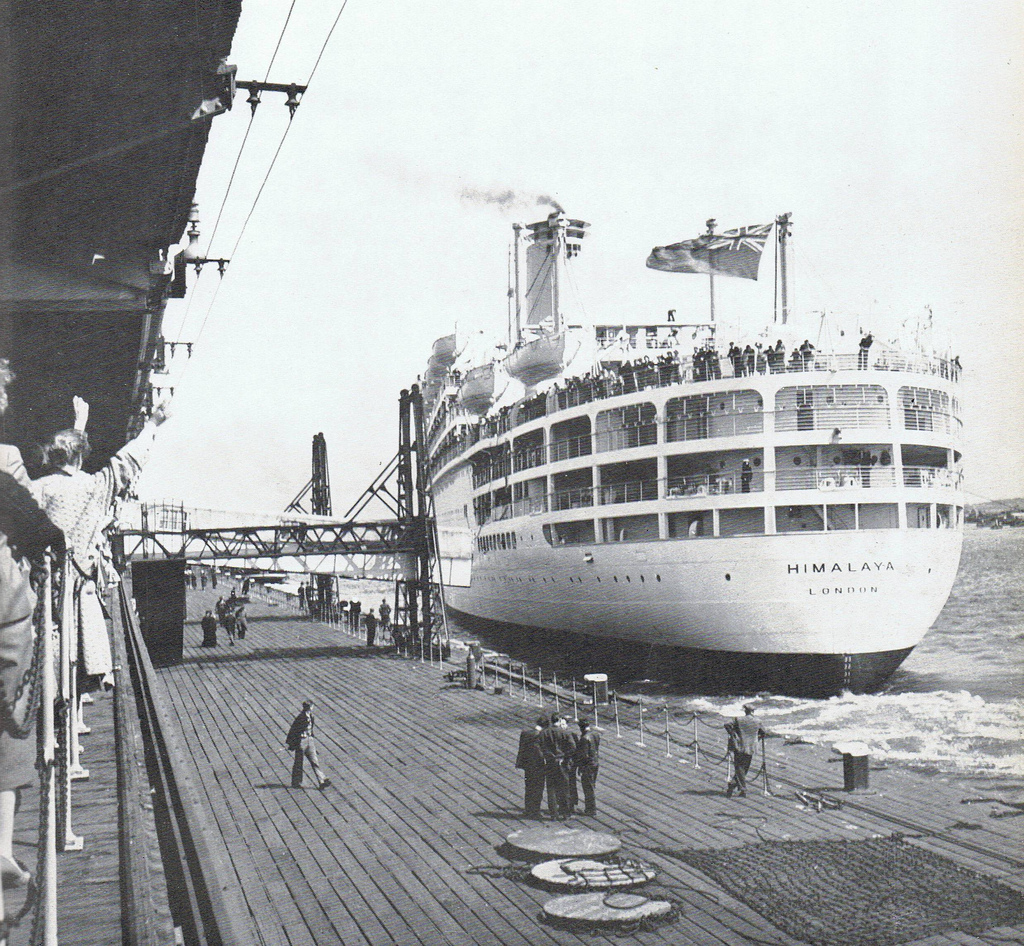
DECISION
Adler v Dickson [1955] 1 QB 158 (the Himalaya)
Tribunal : Queen's Bench Division (UK)
[1954] 2 All ER 397; [1954] 3 WLR 696; 98 Sol Jo 787;
[1954] 2 Lloyd's Rep 267
CA BEFORE : LORD JUSTICE DENNING, LORD JUSTICE JENKINS and LORD JUSTICE MORRIS. 29th October 1954
LORD JUSTICE DENNING:
1. In June, 1952, Mrs Adler, a widow, who keeps a shop, decided to go for a cruise upon the P. & O. Steamship "Himalaya". She booked her passage through the travel agents Thomas Cook & Son. She travelled first-class and paid £188 for the trip. In return the Steamship Company issued her with a first-class passage ticket by virtue of which she joined the ship at Southampton and sailed on the cruise. On the 16th July, 1952, the ship reached Trieste and Mrs Adler went ashore. A gangway was placed horizontally from the ship to a gantry on the quay. She went ashore across that gangway. When she returned to the ship, she was walking along the gangway and had got about half way across when suddenly the gangway came adrift from the gantry at the shore end, and it fell down against the side of the ship. She was thrown on to the wharf below, a distance of 16 feet, and suffered severe injuries, including a broken leg, broken pelvis, and broken ribs. She claims damages against the Master and the Boatswain of the ship alleging that they were negligent in that they failed to see that the gangway was properly secured. They deny this and say that the gangway was properly placed and secured and that the cause of the accident was that there was an exceptionally violent gust of wind which suddenly blew the ship several feet off the quay dragging the gangway with it.
2. On those allegations there is obviously a serious issue as to whether the Master and the Boatswain were negligent or not. The trial of that issue would be very expensive. The Master and Boatswain say that it is unnecessary to go to that expense because in any event, even if they were negligent, they are protected by the exception clause in the ticket. The clause says that "Passengers and their baggage are carried at Passengers' entire risk" and "The Company will not be responsible for and shall be exempt from all liability in respect of any damage or injury whatsoever of or to the person of any passenger". Mrs Adler admits that, if she had sued the Steamship Company, the exemption clause would have protected the Company; but she says that it does not protect the Master and Boatswain. Indeed, it is for that very reason, so as to overcome the exemption clause, that she has sued the Master and Boatswain and not the Steamship Company.
3. This raises a point of law which the Court has ordered to be tried first before the facts are gone into. We must assume for the purposes of the argument that the Master and the Boatswain were personally guilty of negligence and are prima facie liable in tort for their wrongdoing. The question is whether they are protected by the exemption clause. It is an important question, because the Steamship Company say that, as good employers, they will stand behind the Master and Boatswain and meet any damages or costs that may be awarded against them. They say that if Mrs Adler's claim is admissible, it means that a way has been found of getting round the exemption clause which no one has ever thought of before.
4. pause to say that, if a way round has been found, it would not shock me in the least. I am much more shocked by the extreme width of this exemption clause which exempts the Company from all liability whatsoever to the passenger. It exempts the Company from liability for any acts, default or negligence of their servants under any circumstances whatsoever, which includes, I suppose, their wilful misconduct. And this exemption is imposed on the passenger by a ticket which is said to constitute a contract but which she has no real opportunity of accepting or rejecting. It is a standard printed form upon which the Company insist and from which they would not depart, I suppose, in favour of any individual passenger. The effect of it is that, if the passenger is to travel at all, she must travel at her own risk. She is not even given the option of travelling at the Company's risk on paying a higher fare. She pays the highest fare, first-class, and yet has no remedy against the Company for negligence.
Nearly 100 years ago Mr Justice Blackburn in a memorable Judgment said that a condition exempting a carrier wholly from liability for the neglect and default of their servants was unreasonable, see . I think so too.
5. Nevertheless, no matter how unreasonable it is, the law permits a carrier by special contract to impose such a condition; see : except in those cases where Parliament has intervened to prevent it. Parliament has not so intervened in the case of carriers by sea. The Steamship Company are therefore entitled to the protection of these clauses, as indeed this Court held in Law Reports, . The question is whether the Master and the Boatswain — the actual wrongdoers — are entitled also to the protection of them.
6. I can imagine that some lawyers would decide in Mrs Adler's favour out of hand: and for a reason which appears at first sight both simple and sufficient. It is this: The Master and Boatswain were not parties to the contract of carriage and cannot therefore claim the benefit of the exemption clause in it, because no one can enforce a contract to which he was not a party. It was reasoning on those lines which appealed to the Court in : and if that decision was right, it concludes the case in Mrs Adler's favour. Mr Mocatta has, however, urged us to say that that decision was wrong. It is, he says, inconsistent with the decision of the House of Lords in the case of which was not cited to the Court. He says further that, in the case of carriage of goods by sea, it is well established that the Master and crew are entitled to the protection of the exemption clauses: and that there is no reason why they should not also be so entitled in the carriage of passengers.
7. This is a serious argument which makes it necessary for us to consider the cases on carriage of goods. They undoubtedly show that when a carrier issues a bill of lading for goods, the exception clauses therein ensure for the benefit, not only of the carrier himself, but also for the benefit of the shipowner, the Master, the stevedores and any other persons who may be engaged in carrying out the services provided for by the contract. Such persons are not parties to the contract of carriage, but nevertheless when they are rendering their services, they are protected by the exceptions contained therein ; and this is so, even though the clauses are not expressed to be made for their benefit, at any rate, not in so many words. It follows that if they are guilty of negligence in rendering their services and are sued in tort, they can nevertheless rely on the exceptions to relieve them from liability. These propositions have been established in England by the case of , in Australia by , and , and in the United States of America by , and . The propositions are further supported by the Rules in the Carriage of Goods by Sea Act, 1924. Article IV (2) exempts "the carrier" and "the ship" from divers responsibilities and Article IV (5) limits their liability in any event to £100 per package. Neither the Master nor the crew nor the stevedores are expressly given the benefit of these exceptions and limitations but Parliament must have intended that they should have the benefit of them.
8. There was much discussion before us as to the true principle underlying these propositions. No one doubted their correctness but the difficulty is to reconcile them with the proposition that no one can claim the benefit of a contract except a party to it. The speeches in the House of Lords in the Elder Dempster case are so compressed on this point that we have a variety of reasons to choose from. One suggestion which was much canvassed was that, in addition to the contract of carriage between the goods owner and the carrier (which was evidenced by the bill of lading), there were a number of collateral contracts between the goods owner and all the various persons concerned in the carriage. Take, for instance, the stevedores. It was said that there was a collateral contract between the goods owner and the stevedores whereby the, goods owner agreed that the stevedores should have the benefit of the exceptions.
This collateral contract was said to be made by the carriers either as agents for the goods owner or as agents for the stevedores or alternatively to arise out of a bailment upon terms. Take next the crew. It was said that there were collateral contracts with each of them, although there was clearly no bailment to each one. This suggestion of a large number of collateral contracts does not appeal to me, for the simple reason that there are never any such contracts in fact. The goods owner makes one contract only, namely, his contract with the carrier. He makes no contract with anyone else. In particular he makes no contract with the stevedores, or with the Master or the crew. It seems to me that these supposed collateral contracts are nothing but a legal fiction devised to give the stevedores and the others protection under a contract to which they were not parties. The truth is there was only one contract, namely, the contract evidenced by the bill of lading: and the reason why the stevedores and others are protected is because, although they were not parties to the contract, nevertheless they participated in the performance of it, and the exception clause was made for their benefit whilst they were so performing it. The clause was not made expressly for their benefit, it is true, but nevertheless it was by necessary implication which is just as good: and they have a sufficient interest to entitle them to enforce it. Their interest lies in this: they participated in so far as it affected them and can take those benefits of it which appertain, to their interest therein. It is one of those cases — by no means rare — where a third person is entitled to enforce a contract made for his benefit. I referred to some of these cases in, and Mr Justice Devlin has recently mentioned some more in his illuminating Judgment in .
9. Such being the rule in respect of goods, the question is whether a similar rule applies to the carriage of passengers? In principle it clearly does. A good instance is, which was decided eighty years ago. A drover was given a free pass to take some sheep on the railway from Scotland to England. The North British Company gave him a ticket which said that, as he travelled free, he travelled at his own risk. His journey took him over an English line, the North Eastern Railway, and he was injured by the negligence of the servants of the English Company, not by the servants of the Scottish Company. It was admitted that there was only one contract, namely, the contract with the Scottish Company. The English Company was not a party to that contract but nevertheless it was entitled to the benefit of the exception which it contained. The reason was, in Mr Justice Blackburn's words, that the drover "must be taken to have assented that the ticket should protect the North Eastern Company just as well as the North British". In short it was a necessary implication that the English Company should be protected. I should add that in Mr Justice Blackburn's Judgment as reported in the Law Reports there are some words which suggest a contract between the drover and the English Company but the suggestion seems to me unreal as I notice that the Law Journal (44 Law Journal, Queen's Bench, page 164) does not contain those words. In further support of the rule in respect of passengers, I would refer to the Carriage by Air Act, 1932. The provisions under that Act contain certain exemptions and limitations in favour of the "carrier". The pilot of the aircraft is not expressly given the benefit of them, but Parliament must have intended that he should have the same protection as the carrier.
10. My conclusion therefore is that, in the carriage of passengers as well as of goods, the law permits a carrier to stipulate for exemption from liability not only for himself but also for those whom he engages to carry out the contract: and this can be done by necessary implication as well as by express words. When such a stipulation is made, it is effective to protect those who render services under the contract, although they were not parties to it, subject however to this important qualification: The injured party must assent to the exemption of those persons. His assent may be given expressly or by necessary implication, but assent he must before he is bound: for it is clear law that an injured party is not to be deprived of his rights at common law except by a contract freely and deliberately entered into by him; and all the more so when the wrongdoer was not a party to the contract, but only participated in the performance of it.
11. In all cases where the wrongdoer has escaped it will be found that the injured party assented expressly or by necessary implication to forego his remedy against him. In the case of goods it is not difficult to infer an assent because the owner of the goods habitually insures them against loss or damage in transit. If the carrier is protected by an exemption clause, so should his servants be, leaving the owner to recover against the insurance company. As Lord Justice Scrutton said in the Elder Dempster case: "Were it otherwise there would be an easy way round the bill of lading"; and as Lord Finlay said: "It would be absurd that the owner of the goods could get rid of the protective clauses of the bill of lading ... by suing ... in tort".
12. In the case of passengers, however, it is not so easy to infer an assent. It was inferred in Hall v. North Eastern Railway Company but not in Cosgrove v. Horsfalleven though the clause there purported expressly to exempt the servant. At least, that seems to me the correct explanation of those cases.
13. Applying those principles to the present case, the important thing to notice is that the Steamship Company only stipulated for exemption from liability for themselves. They did not in terms stipulate for exemption for their servants or agents, and I see no reason to imply any such exemption. The servants or agents are therefore not excused from the consequences of their personal negligence, see. In any case, even if the Company intended that the stipulation should cover their servants, nevertheless I see nothing whatever to suggest that Mrs Adler knew of their intention or assented to it. If she read the conditions of the ticket (which she probably did not) and considered the possibility of being injured by the negligence or default of the Company's servants (which I trust she thought unlikely) she might well think that her remedy against the Company was barred, but she would not think her remedy against the servants was also barred. Suppose a steward on a liner were to strike a passenger or falsely to imprison her, or injure her by some wilful misconduct, then albeit it was done in the course of his employment, he could not claim the protection of the clause, for the simple reason that the passenger never agreed to his being exempted. She could sue the steward personally, even though her remedy against the Company was barred. So also if the steward is negligent in the course of his employment, for there is no difference in principle between the cases. The passenger has not agreed to forego his remedy against the actual wrongdoer and can still pursue it.
14. The result in my opinion is that Mrs Adler can pursue her claim against the Master and the Boatswain without being defeated by the exemption clause. I think the appeal should be dismissed.
LORD JUSTICE JENKINS:
15. This appeal arises in an action brought by the Respondent/Plaintiff, Mrs. Rose Marks Adler, against the Appellant/Defendants, Dickson and Wallis, respectively Master and Boatswain of the P. & O. Steam Navigation Company's steamship "Himalaya", in the following circumstances.
16. On the 15th or 16th July, 1952, the "Himalaya", in which the Plaintiff was travelling as a first-class passenger, was lying berthed at Trieste in the course of a Mediterranean cruise, and gangways had been placed between the ship and the shore to enable passengers to go ashore and return on board. The Plaintiff had been on shore and was walking along one of these gangways on her way back to the ship when it suddenly moved and fell to the side of the ship, with the result that the Plaintiff was thrown from the gangway on to the wharf, some 16 feet below, and sustained serious injuries.
17. The contract between the Company and the Plaintiff, as evidenced by the ticket issued to her by the Company, included the following provisions. Printed on the ticket itself were the words: "Your attention is specially directed to the conditions of transportation on the covers containing this ticket. Passengers and their baggage are carried at passengers entire risk".
18. Printed on the inside front cover were certain conditions which (so far as material for the present purpose) ran thus: "Conditions and Regulations. This ticket is issued by the Company and accepted by the passenger subject to the following conditions and regulations. The Company will not be responsible for and shall be exempt from all liability in respect of any......injury whatsoever of or to the person of any passenger......whether such injury of or to the person of any passenger.......shall occur on land, on shipboard or elsewhere......and whether the same shall arise from or be occasioned by the negligence of the Company's servants on board the ship or on land in the discharge of their duties, or while the passenger is embarking or disembarking, or whether by the negligence of other persons directly or indirectly in the employment or service of the Company, or otherwise, or by the Act of God......dangers of the seas......or by accidents......or any acts, defaults or negligence of the....... Master, Mariners.......Company's agents or servants of any kind under any circumstances whatsoever.....".
19. The above-quoted provisions of the contract admittedly precluded the Plaintiff from suing the Company for damages in respect of the injuries she had sustained, even if the accident could be shown to have been due to the negligence of the Company's servants. She therefore brought the present action against the Defendants, Dickson and Wallis, claiming damages from them on the ground that the injuries she had sustained through the fall of the gangway were caused by their negligence. The way in which this claim is formulated appears from the following passages in the Statement of Claim:
"4. The Defendants in the course of their respective duties as Master and Boatswain of the ship were, and each of them was, responsible for berthing the said ship at Trieste and for placing and maintaining gangways leading from the said ship to the shore so as to enable the passengers of the said ship to go ashore and to return to the said ship, and such berthing and the placing and maintaining of such gangways were carried out under the supervision, control, management and direction of the Defendants and each of them, who at all material times well knew and intended that the Plaintiff should use the said gangway.
6. The said injuries and loss and damage" (i.e. those resulting from the accident as described and particularised in paragraph 5) "were occasioned to the Plaintiff by reason of the negligence and/ or breach of duty on the part of the Defendants and each of them".
20. Then follow a number of sub-paragraphs of particulars of the alleged negligence and/or breach of duty, from which I select the following:
"(a) Failing to make any or adequate precautions for the safety of the Plaintiff in the use which they knew or ought to have known she would be making of the said gangway.
(b) Causing or permitting the said gangway to be placed from the ship to the shore without taking any or any adequate or effective measures to ensure that it was and would remain safe and secure for the Plaintiff to use.
(c) Causing or permitting the said gangway to be used by the Passengers of the said ship, including the Plaintiff, without taking any or any adequate measures to ensure that the same was properly and effectively secured and made fast and would not and could not move suddenly while the Plaintiff was lawfully using the same,
(e) Causing or permitting the Plaintiff to use the said gangway without first ascertaining or ensuring that it was safe for her to do so, and when they knew or ought to have known it was in an unsafe, unstable and insecure state and condition, and was a danger and trap for the Plaintiff to use.
(g) Failing to make any or any adequate measures or to provide any or any proper system to maintain the said gangway in a safe and secure state and condition".
21. The Defendants by their Defence pleaded (inter alia) the material provisions of the ticket issed to the Plaintiff, to which I have already referred, and founded upon them (in paragraph 3 of the Defence) the following conditions:
"3. The accident to the Plaintiff referred to in the Statement of Claim......occurred while the Plaintiff was a passenger on the 'Himalaya' upon the terms of the said ticket. If (which is denied) either of the Defendants was personally responsible for the safety of the gangway......then the Defendants' acts or omissions (if any) in relation to the said gangway and any other material acts or omissions on the part of either of the Defendants took place in pursuance or performance of the contract between the Plaintiff and the Peninsular and Oriental Steam Navigation Company (herein referred to as 'the Company') as contained in or evidenced by the Plaintiff's said ticket and/or subject to the terms of the said ticket and the Defendants are in the premises entitled to rely upon the terms of the said ticket. Further or alternatively any such acts or omissions on the part of either of the Defendants occurred while the Defendants were acting as the servants or agents of the Company and the Defendants are accordingly entitled to the same protection as that afforded to the Company by the terms of the said ticket. Further or alternatively in contracting with the Plaintiff upon the terms of the said ticket the Company acted in all material respects as the agent of its servants and agents (including the Defendants) and thereby exempted the Defendants from any liability such as is referred to in the Statement of Claim. The said agency arises by implication of law. Further or alternatively by reason of her acceptance of the ticket and of the terms thereof the Plaintiff expressly or impliedly agreed to travel in all respects at her own risk and/or impliedly agreed with the Company's servants and agents (including the Defendants) that they should be under no liability to the Plaintiff in connection with any injury sustained by her as a passenger on the 'Himalaya'".
22. On the 14th June, 1954, an Order was made under the Rules of the Supreme Court, Order 25, Rule 2, for the trial as a preliminary issue of the point of law raised by paragraph 3 of the Defense, namely, whether the terms of the ticket held by the Plaintiff as a passenger on the ship at the time of the accident, afforded a defence to the Defendants against the Plaintiff's claim upon the assumption that the Plaintiff could establish the matters referred to in her Statement of Claim. This issue was argued before Mr. Justice Pilcher on the 19th and 20th July, 1954, and on the 30th July he delivered a reserved Judgment determining it in the Plaintiff's favour, andmade an Order to that effect, from which the Defendants now appeal to this Court. If the matter were free from authority I would have little hesitation in agreeing with the learned Judge's conclusion. For the present purpose it must be assumed that the Defendants were in fact guilty of the negligence alleged against them in the Statement of Claim in the shape of the various wrongful acts or omissions particularised under paragraph 6, and the Defendants must show that even on that assumption the action must fail by reason of the exempting provisions of the ticket. On this assumption, the Plaintiff, while lawfully using the gangway, was injured by the tortious acts or omissions of the Defendants who were servants of the Company which had contracted with the Plaintiff to carry her as a passenger. If her contract with the Company had contained no exempting provisions, the Plaintiff would, as I understand the law, have had separate and distinct rights of action (a) against the
Company for breach of contract or alternatively, in tort on the principle of "respondeat superior", and (b) against the Defendants as the persons actually guilty of the tortious acts or omissions which caused the damage. The plaintiff's right of action against the Company is clearly taken away by the exempting provisions of the contract, but I fail to see how that can have the effect of depriving her also of her separate and distinct right of action against the Defendants as the actual tortfeasors. There is certainly no express provision purporting so to deprive her, and in the absence of any express provision to that effect I see no justification for implying one.
The exempting provisions in terms apply only to the liability of the Company, without any reference to the liability of servants of the Company for the consequences of their own tortious acts. Even if these provisions had contained words purporting to exclude the liability of the Company's servants, non constat that the Company's servants could successfully rely on that exclusion in proceedings brought against them by some party injured by their tortious conduct, for the Company's servants are not parties to the contract. But as it is, not only are the Company's servants not parties to the contract, but the contract docs not even mention their liability. I find it quite impossible to accept the suggestion that the contract between the Company and the Plaintiff must be taken to have been entered into by the Company not only on its own behalf but also on behalf of all its servants. There is nothing whatever in the terms of the contract to support this theory, and even if it were tenable I do not see how it would assist the Defendants, inasmuch as the only liability it excludes is the liability of the Company. Finally, I take it to be the law that a Defendant sued in tort who claims that the Plaintiff has by some contract with the Defendant deprived himself in advance of his right of action in respect of the wrong done him must show that the contract relied on does either expressly or by necessary implication clearly deprive the Plaintiff of such right. The contract here relied on to my mind falls far short of this test so far as the Plaintiff's right of action against the Defendants is concerned.
23. A good deal was said in the course of the argument before us about the absurdity of a stipulation relieving an employer of his liability for the negligence of his servant while leaving untouched the servant's liability for that some negligence. I do not follow this. If there is no exempting stipulation at all, then both master and servant are liable, and either can be sued at the option of the injured party. If there is a contract exempting the master but not the servant then the servant's liability remains as it was. The master may find this result inconvenient if he feels impelled either from motives of expediency or from a sense of moral obligation to indemnify the servant. But, if so, the answer is simple. He should have seen that the contract was so framed as to exempt his servant from liability as well as himself. To my mind it is far more absurd to impute to a passenger on a ship who has contracted with a shipowner for a given voyage in terms which exempt the shipowner from liability for his servants' negligence an intention thereby to deprive himself of all right to redress against the servants of the shipowner for any and every negligent act or omission which may be committed by such servants in the course of their duties, however gross the negligence and however grave the resulting damage to the passenger may be.
Accordingly, if left free to do so by the authorities, I would dismiss the appeal.
24. The conclusion which I have thus provisionally reached accords with the decision of this Court in the case of . In that case the Plaintiff, Cosgrove, an omnibus driver employed by the London Passenger Transport Board, was provided by the Board with a free pass which allowed him to travel on the Board's omnibuses subject to the condition that, except when he was travelling on the Board's business, neither the Board nor their servants would be liable to him or his representatives "for loss of life injury or delay, or of damage to property however caused". While the Plaintiff was travelling otherwise than on the business of the Board on one of the Board's omnibuses it came into collision with another of the Board's omnibuses and the Plaintiff was injured, through the negligence of the driver of one of the omnibuses.
The Plaintiff sued the two drivers in the County Court. The County Court Judge held that one of the two drivers, the Defendant Horsfall, was to blame for the accident and awarded the Plaintiff £20 damages against that Defendant, who appealed unsuccessfully to this Court, It is I think right to quote at some length from the Judgment of Lord Justice Du Parcq (as he then was) with which the other members of the Court (Lord Justice Scott and Lord Justice Morton, as he then was) expressed their concurrence. Lord Justice Du Parcq said this:
"The Plaintiff in this case has suffered injury and damage by reason of the negligence of the defendant Horsfall. Why, then, should he not recover damages against that Defendant? The only answer is that the plaintiff is bound by contract, or, alternatively, by a condition attached to a licence, not to hold the defendant liable. The Judge held that this defence could not avail the defendant Horsfall, since he was not a party to the contract and did not grant the licence or impose the condition. At first sight this decision seems to be plainly right, and to be founded on an elementary principle of our law. It has, however, been criticised on diverse grounds and with much ingenuity. In my opinion the attack on it wholly failed. It was said that, in making the contract, or imposing the condition, the London Passenger Transport Board wore acting as agents for Horsfall, so that he could take advantage of the conditions and rely on it. There was no evidence before the Judge on which he could have found that the board acted as agents for Horsfall, and, of course, he did not so find. It was not even proved that Horsfall was in the employment of the board when the pass, on which the condition is indorsed, was issued to the Plaintiff. If I assume that Horsfall was then in the board's employment it remains true that there is no evidence from which agency ought to be inferred. I agree with the Judge that Horsfall 'was not a party to and has no right by virtue of the licence or contract'. It was further argued for Horsfall that the plaintiff was bound to produce and rely on his pass in order to show that he was lawfully in the omnibus when he was injured, and that, having once produced it and relied on it, he must be held bound by all its terms, so that he could not ask the Court to hold any servant of the board liable in respect of his injury or damage. Thus, it was said, Horsfall must escape. We heard much of 'blowing hot and cold' and of 'approbating and reprobating' and it would seem that the latter expression is not yet as outmoded as in 1940 Lord Atkin supposed it would become: see United AustraliaLimited v. Barclays Bank, Limited (57 The Times Law Reports 13, at page 21; 1941 Appeal Cases, 1, at page 32). In the end it appeared (if I rightly understood the argument) that the submission was founded on the equitable doctrine of election. In my opinion Horsfall cannot rely on any such doctrine here. In order to show that the driver of the omnibus was under a duty to the plaintiff to take reasonable care for his safety, all that the plaintiff had to prove was that at the time of the accident he was lawfully in the omnibus. It may be that it was necessary to produce the pass in order to show that he was in the omnibus with the consent of the board, and, no doubt, its production reveals the fact that after the accident had happened the plaintiff broke one of the conditions by which, as between the board and himself, he was bound. But this cannot retrospectively make him a trespasser, or invalidate his claim to have been a passenger with the consent of the board. There is, in my opinion, nothing in the point".
25. I understand Lord Justice Du Parcq's reference to the Plaintiff's breach of one of the conditions by which as between the Board and himself he was bound to be directed to the fact that the condition there in question stipulated that neither the Board nor their servants should be liable, an element in the case then before the Court which has no counterpart here, as in the present case the exemption is in terms accorded only to the Company itself. Cosgrove v. Horsfall seems to me to be directly in point and, prima face, it must be our duty to follow tat decision as a decision of this Court which is binding upon us, with the result that the present appeal must fail.
26. It was, however, strenuously argued on behalf of the Appellants that Cosgrove v. Horsfall is in conflict with the earlier decision of the House of Lords in the case of Elder Dempster & Co. Ltd. and Ors. v. Paterson, Zochonis & Co. Ltd., 1924 Appeal Cases, 522, which apparently was not cited in Cosgrove v. Horsfall, and which is relied on for the Appellants as establishing the general proposition that where "A" contracts to render services to "B" on terms that "A" is not to be liable to "B" for damage caused by the negligence of "A's" servants or agents, and in the course of the performance of the contract "A's" servant or agent is guilty of negligence causing damage to "B", "A's" servant or agent is entitled to the same immunity from suit as is accorded to "A", his master or principal, by the exempting condition, and this notwithstanding that the negligence of the servant or agent is such as would clearly have entitled "B" to maintain an action against him in tort apart from the exempting condition. It would seem that the only limit to be placed on this sweeping proposition is that the negligence of the servant or agent must consist in something done or omitted by him in the course of the performance of the contract, a limit the precise scope of which is by no means easy of definition. If the case of Cosgrove v. Horsfall does indeed conflict with the Elder Dempster case, and if the Elder Dempster case does indeed establish the general proposition stated above, then it must be our duty to reject Cosgrove v. Horsfall as of no authority, to follow the Elder Dempster case, and accordingly to allow this appeal.
27. It is therefore necessary to examine the Elder Dempster case in some detail. The facts were somewhat complicated and unusual. The defendants, Elder Dempster & Co. Ltd., employed a number of ships in the West African trade, which included the carriage of palm oil in casks from West African ports to this country. They hired the use of the steamship "Grelwen" on time charter from her owners, the Defendants, Griffiths Lewis Steam Navigation Co. Ltd., in order to run her as one of their line of steamships engaged in this trade. The Plaintiff, Paterson Zochonis & Co. Ltd. Were the owners of a quantity of casks of palm oil which were taken on board the"Grelwen" at two West African ports for carriage to Hull under bills of lading issued in the names of "The African Steamship Company and the British and African Steam Navigation Co. Managers Elder Dempster & Co". The bills of lading contained clauses which provided that "the shipowners hereinafter called the Company", should not be liable for loss or damage arising from a variety of happenings, which for the present purpose I need not particularise beyond saying that they had the effect of exempting "the Company" (i.e. by definition "the Shipowners") from liability for damage due to the negligent stowage of the goods by the servants or agents of "the Company". The bills were signed by the Master of the "Grelwen" as "agent of the Company". Large quantities of palm kernels in bags were stowed above the casks of oil, and as there were no tweendecks to take the weight of these bags, it bore directly upon the casks with the result that many of the casks were crushed and, in consequence, much of the oil escaped and was lost. It appears that ships regularly engaged in the West African trade were usually fitted with tweendecks for the very purpose of relieving any casks of palm oil carried from the weight of superincumbered cargo. In these circumstances, Paterson Zochonis . Co. Ltd. (whom I will call "the Shippers") sued Elder Dempster & Co. Ltd., the African Steamship Co., and the British – African Steam Navigation Co (whom I will call collectively "the Charterers", and also the Griffiths Lewis Steam Navigation Co. Ltd. (whom I will call "the Grelwen's owners") for damage in respect of the loss of the oil.
28. The claim was based, in effect, on two grounds, viz: (a) that the Defendants had been negligent in stowing the Plaintiffs' oil, and (b) that the ship was unseaworthy, in that it was structurally unfit for the carriage of the Plaintiffs' oil. Mr. Justice Rowlatt held that the ship was unseaworthy for the carriage of this cargo, and that none of the exceptions in the bills of lading covered a claim based on unseaworthiness, and gave Judgment for the Plaintiffs accordingly.
29. On appeal to the Court of Appeal (1923 1 King's Bench, page 420, the Court, by a majority (Lord Justice Bankes and Mr. Justice Eve , Lord Justice Scrutton dissenting) upheld Mr. Justice Rowlatt's decision. In his dissenting judgment Lord Justice Scrutton, after rejecting the shippers' claim so far as based on unseaworthiness, dealt with their contention that the loss was due to bad stowage. On this part of their case the shippers admitted that the charterers were protected from liability by the exceptions in the Bills of Lading, but contended that the "Grelwen's" owners were liable in tort on the ground that the master and crew were in the service of the "Grelwen's" owners as owners of the ship, that their conduct in putting an excessive weight on the palm oil barrels amounted to a tort for which the "Grelwen's" owners were liable as having been committed by their servants and that the "Grelwen's" owners, not being parties to the bills of lading, could not claim the benefit of the exceptions contained in them. In dealing with this contention Lord Justice Strutton at page 441 of the report, said:
"To this counsel for the owner made reply that the owner in the case of a time charter like the present one was not in possession of the goods. This in my opinion is contrary to all the authorities, of which Omoa Coal Co. v. Huntley is a type. The real answer to the claim is in my view that the shipowner is not in possession as a bailee, but as the agent of a person, the charterer with whom the owner of the goods has made a contract defining his liability, and that the owner as servant or agent of the charterer can claim the same protection as the charterer. Were it otherwise there would be an easy way round the bill of lading in the case of every chartered ship; the owner of the goods would simply sue the owner of the ship and ignore the bill oflading exceptions, though he had contracted with the charterer for carriage on those terms and the owner had only received the goods as agent for the charterer".
30. On appeal to the House of Lords, the House by a majority (Viscount Cave, Lord Dunedin, Lord Sumner and Lord Carson; Viscount Finlay dissenting) reversed the decision of the Court of Appeal, holding that the loss was due to bad stowage and not to unseaworthiness, and that the claim in tort against the "Grelwen's" owners failed because they were (as Lord Justice Scrutton had held) entitled to the benefit of the exception of liability-contained in the bills of lading. So far as this claim in tort as concerned, Viscount Finlay agreed with the rest of their Lordships, so that the decision may be said to have been unanimous as to the result on that part of the case, though there were differences of some importance in the reasoning by which they severally arrived at their conclusion. In 1924 Appeal Cases, page 533, Viscount Cave said: I do not think that this argument should prevail. It was stipulated in the bills of lading that "the shipowners" should not be liable for any damage arising from other goods by stowage or contact with the goods shipped under the bills of lading; and it appears to me that this was intended to be a stipulation on behalf of all the persons interested in the ship, that is to say, charterers and parties to the contract; but they took possession of the goods (as Lord Justice Scurtton says) on behalf of and as the agents of the charterers, and so can claim the same protection as their principals.
Viscount Finlay at page 547 said: "It appears to me that if the plaintiffs are to succeed it must be upon the bill of lading. The owners of the goods put them on board the 'Grelwen' to be carried on the terms of the bill of lading. It is said that the imposition of the weight of the kernels on the top of the palm oil barrels was a wrongful act, resulting in the destruction of the barrels and the loss of the oil, and that for this wrongful act, committed by their servants, the shipowners are liable, apart from contract altogether, so that the plaintiffs, in claiming from the shipowners, would not be hampered by the conditions of the bill of lading. This contention seems to me to overlook the fact that the act complained of was done in the course of the stowage under the bill of lading, and that the bill of lading provided that the owners are not to be liable for bad stowage. If the act complained of had been an independent tort unconnected with the performance of the contract evidenced by the bill of lading, the case would have been different. But when the act is done in the course of rendering the very services provided for in the bill of lading, the limitation on liability therein contained must attach, whatever the form of the action and whether owner or charterer be sued. It would be absurd that the owner of the goods could get rid of the protective clauses of the bill of lading, in respect of all stowage, by suing the owner of the ship in tort. The Court of Appeal were, in my opinion, right in rejecting this contention, which would lead to results so extraordinary as those referred to by Lord Justice Scrutton in his judgment".
31. Lord Sumner (with whom Lord Dunedin concurred) said, at page 564: "It may be, that in the circumstances of this case the obligations to be inferred from the reception of the cargo for carriage to the United Kingdom amount to a bailment upon terms, which include the exceptions and limitations of liability stipulated in the known and contemplated form of bill of lading. It may be, that the vessel being placed in the Elder, Dempster & Co's line, the captain signs the bills of lading and takes possession of the cargo only as agent for the charterers, though the time charter recognises the ship's possessory lien for hire. The former I regard as thepreferable view, but, be this as it may, I cannot find here any such bald bailment with unrestricted liability, or such tortious handling entirely independent of contract, as would be necessary to support the contention".
Lord Carson expressed his concurrence in the judgments of Lord Cave and Lord Sumner.
32. It will be seen that Lord Cave based himself in part at all events on the view that the stipulation that "the shipowners" should not be liable for (to put it shortly) bad stowage was intended to be a stipulation on behalf of all the persons interested in the ship that is to say both the charterers and the "Grelwen's" owners; and while he added that the "Grelwen's" owners took possession of the goods (as Lord Justice Scrutton had said) on behalf of and as the agents of the charterers and so could claim the same protection as their principals, he prefaced this by the words "It may be that the owners" (i.e. the "Grelwen's" owners) "were not directly parties to the contract", which suggest that in his view the 'Grelwen's' owners by taking possession of the goods on the charterers behalf became indirectly parties to the contract and therefore entitled to the benfit of the exceptions contained in it.
33. Lord Finlay founded himself on the view that the shippers put the goods on board the "Grelwen" to be carried on the terms of the bills of lading; that the act complained of was done in the course of stowage under the bills of lading which provided against liability for bad stowage; and that there was no independent tort unconnected with the performance of the contract. Finally, Lord Sumner based his conclusion either upon the ground that the reception of the cargo amounted to a bailment on terms which included the exceptions stipulated in the bill of lading, or upon the ground that the captain of the "Grelwen" took possession of the cargo only as agent for the charterers, expressing a preference for the former view. To my mind these passages from their Lordships' speeches fall far short of establishing the general proposition contended for by the Defendants in the present case.
34. It is, to my mind, clear that the words "the Company will not be responsible" in the conditions of the Plaintiff's ticket cannot be extended so as to include the Defendants in the way in which Lord Cave thought the somewhat ambiguous expression "the shipowners" in the bills of lading should be construed as including the "Grelwen's" owners as persons interested in the ship. Again, it is to my mind clear that the Defendants cannot be said to have become parties to a contract with the Plaintiff in the terms of the Plaintiff's ticket upon the Plaintiff going on board the "Himalaya" as a passenger. Moreover, in the Elder Dempster case it was not sought to make the "Grelwen's" owners liable for any tortious act committed by them personally, but to make them vicariously liable for the negligence of the Master and crew on the principle of respondeat superior. It is by no means to be assumed that the result would have been the same if one of the "Grelwen's" crew had been sued for a tortious act committed by him personally in the course of the stowage of the goods.
35. In the present case, the Plaintiff, just as the Plaintiff in Cosgrove v. Horsfall had only to prove that he was lawfully on the omnibus, can maintain her action merely by showing that she was a lawful user of the gangway whom the Defendants knew or ought to have known to be likely to use it; and this being so I think the negligence of which she complains has a sufficient independence from the contract to fall within Lord Finlay's reservation with respect to the case of an independent tort.
36. In sum, the facts in the Elder Dempster case were entirely different from those in the present case, not least in the respects that it was a case of the carriage of goods in a chartered vessel whereas this is a case of the carriage of a passenger in a vessel belonging to the carriers; and that it was a case where it was sought to make the owners of a chartered vessel vicariously responsible for the tortious acts of the Master and crew of that vessel when acting under the orders of the charterers, whereas this is a case where there is a direct claim in tort against the Master and Boatswain of a ship by a passenger travelling in the ship. The Elder Dempster case can well be explained by reference to its own facts without ascribing to their Lordships any intention to lay down any such general principle as the Defendants here contend for, nor do I think that their Lordships' language, carefully directed as it was to the particular facts of the case then before the House, can fairly be construed as doing so.
37. It is interesting to note that in the case of Mersey Shippin and Transport Co. Ltd. v. Rea Ltd. (21 Lloyds List, page 375) Lord Justice Bankes and Lord Justice Scrutton sitting in a Divisional Court as additional judges of the King's Bench Division expressed divergent views as to the effect of the Elder Dempster case Lord Justice Bankes said at page 377:
"But the Court t here held that under the circumstances of the vessel being chartered to form one of the owners' regular line, the proper inference to draw was that the goods were shipped under conditions which could cover both charterer and shipowner".
Lord Justice Scrutton said, at page 378:
"I think that the reasoning of the House of Lords in the Elder Dempster case shows that, where there is a contract which contains an exemption clause, the servants or agents who act under that contract have the benefit of the exemption clause. They cannot be sued in tort as independent people, but they can claim the protection of the contract made with their employers on whose behalf they are acting. I think that is the result of the second point in the judgments of Lord Cave and of Lord Sumner, with whom Lord Dunedin concurs, in the Elder Dempster case".
38. I prefer the view of Lord Justice Bankes to that of Lord Justice Scrutton which, if accepted, would go far to make good the Defendants' contention here. I should add that Lord Justice Scrutton seems to have misapprehended Lord Sumner's second
point which, as I understand it, was that the Captain of the "Grelwen" should be regarded as acting as agent for the charterers and not as agent for the "Grelwen's" owners whom it was sought to make liable for the Captain's default.
39. For the reasons I have endeavoured to state I cannot accept the view that Cosgrove v. Horsfall is inconsistent with the Elder Dempster case, and I am accordingly of opinion that we must follow Cosgrove v. Horsfall as a decision of this Court directly in point. Many other cases of varying degrees of relevance were cited to us and to the learned Judge. I do not find it necessary to refer to these, for there is nothing in any of them which can be held to destroy the authority of Cosgrove v. Horsfall once that case is absolved of inconsistency with the Elder Dempster case.
Accordingly, I would dismiss this appeal.
LORD JUSTICE MORRIS:
40. If the Plaintiff has suffered injury and damage by reason of the personal negligence or breach of duty of the Defendants or one of them it is said that the Defendants are absolved from liability because the Plaintiff contracted with their employers, the Peninsular and Oriental Steam Navigation Company, that the Company would in such contingency not be responsible. The Plaintiff did not however make a contract with the Company that the servants of the Company would not be responsible to the Plaintiff. Even had there been such a contract, then, unless the Company contracted as agents for their servants, the latter could not claim immunity for their personal torts if the decision of this Court in Cosgrove v. Horsfall (62 Times Law Reports, page 140) is of binding validity.
41. The point of law which has been set down for hearing is as to whether the terms of the ticket held by the Plaintiff afford a defence to the Defendants against the claim of the Plaintiff. On the ticket issued to the Plaintiff it was stated: "Your attention is specially directed to the conditions of transportation on the covers containing this ticket". It was also stated that; "Passengers and their baggage are carried at passengers' entire risk". This must, I think, have reference to and be deemed to be a summary of "the conditions of transportation" to which attention is specially directed. It is to such "conditions" that reference must be made in order to ascertain the terms on which a passenger is carried.
42. The condition which is relied upon by the Defendants begins with the words: "The Company will not be responsible for and shall be exempt from all liability in respect of". There is nothing which states that individual tortfeasors are to be free and exempt from liability. The immunity of the Company is secured by phraseology which is designed to cover every contingency. There is no parsimony in the use of words and the first sentence contains over three hundred of them. It would have been easy to include a few extra words in an attempt to give immunity to the servants or agents of the Company: the absence of such words rather suggests that the scope and design of the condition have reference to securing the immunity of the Company.
43. From the multiform provisions of the protective condition it can be gleaned that: "The Company will not be responsible for and shall be exempt from all liability in respect of any ... loss damage or injury whatsoever of or to the person of any passenger ... and whether such ... injury ... shall occur on land, on ship board or elsewhere ... and whether the same shall arise from ... or by accidents ... or any acts defaults or negligence of ... passengers ... of any kind under any circumstances whatsoever".
44. If one passenger caused injury to another by a tortious act it could hardly be said that the words I have quoted give immunity to the former. There are, of course, in addition many words making the Company immune from the consequences of any negligence of the Company's servants or agents, and it is said that for any tort of a servant or agent for which the Company would apart from the condition be answerable in law a like measure of immunity may be asserted by the servant or agent as that which by contract has been conceded to the Company. The contention is advanced in various ways. It is said that "in contracting with the Plaintiff upon the terms of the said ticket the Company acted in all material respects as the agent of its servants and agents (including the Defendants) and thereby exempted the Defendants from any liability" such as is referred to in the Statement of Claim. The said agency is said to arise by implication of law. But I can see nothing to suggest that the Company acted as the agent of its servants. The Company did not purport to contract on their behalf and there is nothing which as a matter of law suggests that the Plaintiff made a contract with each and every servant of the Company or with those who were likely to sail on the ship on the projected voyage or indeed with any person who might later become a servant and join the ship or with any servant or agent whose conduct might in any way affect the Plaintiff.
45. Alternatively it is urged that the Plaintiff "agreed to travel in all respects at her own risk", and impliedly agreed with the Company's servants and agents that they should be under no liability to the Plaintiff in connection with any injury sustained by her as a passenger. But the agreement made by the Plaintiff was on the terms of the express conditions and it is to them that reference must be made. I can see nothing in them which makes any implication necessary and nothing to suggest that at some time or at various times and in some manner there came into existence a number of contracts between the Plaintiff and various servants or agents of the Defendants who either on the ship or elsewhere might by their conduct in any way affect the Plaintiff.
This contention appears to me to be both vague and unreal.
46. The argument mainly pressed on behalf of the Defendants is that in reference to any acts or omissions occurring while servants or agents of the Company are acting as such servants or agents reliance may be placed upon the terms of the ticket and that the servants or agents are "entitled to the same protection as that afforded to the Company by the terms of the ticket".
47. There are clearly many circumstances which may be imagined in which it would be fair and reasonable that the servants or agents of the Company should be as immune as the Company. Equally there are many circumstances in which such a result would be unfair and unreasonable. Servants might claim civil protection against the consequences of wanton or wicked or criminal acts. But the issue must be resolved not by balancing considerations of convenience but by the application of principle.
48. If a servant of the Company seeks to protect himself from the consequences of a wrongful act he must show that he has made or can claim to be a party to a contract not objectionable on any grounds of public policy by which he is given immunity. In the present case the Defendants can point to no such contract.
49. It is submitted that the binding effect of Cosgrove v. Horsfall (supra) can be challenged because no consideration was given to the decision of the House of Lords in Elder Dempster & Company and others v. Paterson Zochonis & Company (1924 Appeal Cases, page 522). That was a somewhat special case and in my judgment the reasoning in the speeches in the House of Lords did not direct any different conclusion from that which was reached in Cosgrove v. Horsfall. The House of Lords case has been much mentioned in judicial utterances but it is from the authority of the pronouncements in the House of Lords that throughout guidance must be obtained. Lord Sumner was definitely of the opinion in that case that there was no bald bailment of the goods to the Griffiths Lewis Steam Navigation Company with unrestricted liability. The view of the matter which he preferred was that the obligations to be inferred from the reception by the Griffiths Lewis Company of cargo for carriage to the United Kingdom amounted to a bailment upon terms which included "the exceptions and limitations of liability stipulated in the known and contemplated form of bill of lading". Lord Dunedin found that the opinion of Lord
Sumner expressed fully and conclusively the result at which he himself had arrived.
Lord Carson also agreed with Lord Sumner and the fact that he also agreed with Lord Cave showed that he did not consider that there was serious divergence between the reasoning of Lord Cave and Lord Sumner. Lord Cave pointed out that it was stipulated in the bills of lading that "the shipowners" should not be liable for any damage arising from other goods by stowage or contact with the goods shipped under the bills of lading and he considered that "this was intended to be a stipulation on behalf of all the persons interested in the ship, that is to say, charterers and owners alike". Lord Cave added:
"It may be that the owners were not directly parties to the contract; but they took possession of the goods (as Lord Justice Scrutton says) on behalf of and as agents of the charterers and so can claim the same protection as their principals".
50. It seems to me that if when Paterson, Zochonis & Company handed over the goods to the owners (Griffiths Lewis Steam Navigation Company) the latter had said to Paterson, Zochonis & Company: "Whether we are to be deemed to be taking possession of these goods on behalf of and as the agents of the charterers or on some other footing we take it that both you and we intend that the stipulations in the bills of lading are to protect us as well as the charterers?", the answer would unquestionably have been: "Of course".
51. In the circumstances existing at the time that the goods were placed on board there was occasion for an implied contract between those who delivered and those who received. I do not read the decision in the Elder Dempster case as laying it down that if A. makes a contract with B. by which he agrees not to hold B. answerable for the tort of his servant C, that C. is thereby automatically given immunity if he commits a tort against A.
52. Many situations may arise in which a term in a contract between A. and B. can come into play so as to affect C. I do not seek to enumerate these situations but merely to illustrate some of them. Thus there may be a separate contract between A. and C. which impliedly incorporates the term in the contract between A. and B. Also there may arise dealings between A. and C. which are in some way related to or connected with the contract between A. and B. so that the term existing in that contract forms one of the circumstances to be taken into account when defining the duty owed by C. to A. These are apart from cases where C. might be the unnamed principal of B. Further, there may be cases in which A. has expressly or impliedly authorised B, to make on A's behalf a new contract with C, which contains a term similar to that in the contract between A. and B. The case of Hall v. The North Eastern Railway Company (Law Reports, 10 Queen's Bench, page 437) may be regarded as an illustration of this. The Plaintiff made a contract with the North British Company by which as a drover accompanying sheep that were to be carried he was entitled to be carried at his own risk from Angerton to Newcastle N.E. The North British Company did not operate beyond Morpeth: at Morpeth the Plaintiff's carriage was attached to a train of the North Eastern Railway Company and after the train left Morpeth it was run into by another train of the North Eastern Company whose servants were negligent. Mr Justice Blackburn on those facts said (see page 441):"When the Plaintiff went to the North British Company and took a ticket under which he was to be carried from Angerton to Newcastle he in effect agreed that the
North British Company should secure that the North Eastern Company should carry him on from Morpeth to Newcastle: and when he engaged to travel at his own risk he engaged with the North British Company that they should agree with the North Eastern Company that he should be carried on to Newcastle exactly on the same terms as if the North British line extended to Newcastle. It is clear that this is the true construction of the ticket: 'In consideration of my being carried the whole way free of charge I agree that I shall be travelling the whole way at my own risk': and it seems to me that the Plaintiff did authorise the North British Company to contract for him with the North Eastern Company, and what he authorised was that he should travel at his own risk".
53. Many variations of facts may be imagined in which the question arises whether a party is affected by a term in a contract. A recent illustration may be found in Pyrene Co. Ltd. v. Scindia Navigation Co. Ltd., (1954, 2 Weekly Law Reports, page 1005) where Mr Justice Devlin (at page 1019) said: "I think the inference irresistible that it was the intention of all three parties that the seller should participate in the contract of affreightment so far as it affected him".
54. In cases where goods are handed over from one person to another then, unless some express contract defines the position, there is often the necessity upon a consideration of all the facts and circumstances to imply the basis or the terms which have effect. Each case must depend upon its own facts. But whether in relation to goods or generally in all situations immunity from the consequences of some action which would normally in the circumstances give rise to liability at the suit of another must, unless given by law, be secured by contract. Such contract may be express and it may become effective by the operation of the principles of agency: or it may be implied in particular circumstances: but a contract to which the party seeking immunity is a complete stranger will not avail.
55. For the reasons which I have indicated I do not consider that in the present case the Shipping Company was contracting as the agent of those whom it might employ and I see no reason to suppose that the Plaintiff intended to give immunity in wider terms or to a greater extent than is provided for in the words set out on her ticket. In my judgment, the terms of the ticket held by the Plaintiff do not afford a defence to the Defendants and I would decide the preliminary point of law accordingly.
LORD JUSTICE DENNING:
56. The appeal will be dismissed with costs.
MR A.A. MOCATTA, Q.C. and MR MICHAEL KERR (instructed by Messrs Ince & Co.) appeared on behalf of the Appellants (Defendants). MR GODFRAY Le QUESNE (instructed by Messrs Neil Maclean & Co.) appeare
ANALYSE (Conseil d'Etat)
Par la décision Société commerciale de l'Ouest africain, le Tribunal des conflits admet l'existence de services publics fonctionnant dans les mêmes conditions qu'une entreprise privée et donne naissance à la notion de service public industriel et commercial.
La société commerciale de l'Ouest africain était propriétaire de l'une des voitures qui furent gravement endommagées dans l'accident survenu au bac dit d'Eloka, service de liaison maritime situé sur la lagune du littoral de Côte d'Ivoire et exploité directement par la colonie. Aux fins de déterminer le juge compétent pour désigner l'expert dont la société demandait la nomination, le Tribunal des conflits a été amené à se prononcer sur la question de savoir si des services entiers de l'administration peuvent être regardés comme fonctionnant dans les mêmes conditions qu'une entreprise privée, auquel cas le juge compétent est le juge judiciaire.
Il était déjà admis que, pour certaines opérations isolées, l'administration pouvait agir comme un simple particulier sans user de prérogatives de puissance publique. L'admettre pour un service entier était plus délicat. Le Tribunal des conflits valida toutefois cette innovation et donna ainsi naissance, bien que le terme ne soit pas utilisé dans sa décision, à la notion de service public industriel et commercial.
C'est ainsi que des organes essentiellement administratifs, comme les collectivités publiques par exemple, peuvent exploiter de tels services : c'est le cas de l'État s'agissant du service des monnaies et médailles (CE, B..., 9 janvier 1981, n°226521, p. 4). A l'inverse, certains établissements auxquels la loi ou le décret les instituant a attribué un caractère industriel et commercial peuvent cependant exercer partiellement ou totalement des fonctions administratives. Tel est le cas par exemple de l'Office nationale des forêts (TC, 9 juin 1986, Commune de Kintzheim c/ Office national des forêts, p. 448).
Pour identifier un service public industriel et commercial, le juge, loin de s'en tenir aux qualifications parfois trompeuses des textes, à moins qu'ils ne soient de niveau législatif, met en oeuvre plusieurs critères dont les principaux sont l'objet du service, l'origine des ressources, les modalités du fonctionnement.
La qualification d'industriel et commercial donnée par la loi ou par le juge à un service entraîne en principe la compétence du juge judiciaire pour trancher les litiges le concernant. Mais cette compétence n'est pas générale : dans le domaine de la responsabilité en premier lieu, puisque le juge administratif se reconnaît compétent pour connaître des dommages de travaux publics causés à des tiers ainsi que des dommages causés par des services publics industriels et commerciaux dans l'exercice de prérogatives de puissance publique ; dans le domaine des contrats ensuite, puisque certains contrats relatifs à des services publics industriels et commerciaux, si le service est géré par une personne morale de droit public, peuvent avoir le caractère de contrat administratif si le second critère nécessaire à cette qualification est satisfait, ce second critère pouvant prendre plusieurs formes (contrat d'exécution de travaux publics, contrat d'occupation du domaine public, clauses exorbitantes du droit commun et enfin contrat confiant l'exécution même du service public). S'agissant du personnel enfin, les litiges les opposant au service relèvent toujours du juge judiciaire à l'exception du directeur et du comptable, s'il a la qualité de comptable public (Section, 8 mars 1957, J... de L..., n°15219, p. 158). Enfin, le juge administratif est compétent pour juger de la légalité des actes de portée générale des services publics industriels et commerciaux (TC, 15 janvier 1968, Compagnie Air France c/ Epoux Barbier, p. 789).
Tribunal des conflits - 22 janvier 1921- Société commerciale de l'Ouest africain - Rec. Lebon p. 91
24 April 2012
Naufrage du TITANIC le 15 avril 1912 : La première fiche d'une nouvelle série consacrée aux Fortunes de Mer du passé
- Article Details
- Published on 24 April 2012
- Category Major cases
 Voila plusieurs mois que cette idée nous taraudait d'évoquer sur notre site les fortunes de mer du passé et offrir ainsi de nouvelles fiches sinistres consacrées aux grands naufrages du passé. Il sera bien entendu assez difficile d'évoquer toutes les grandes fortunes de mer mais certaines sont plus emblématiques que d'autres et ont laissé leur empreinte dans l'histoire et l'imaginaire collectif. A l'opposé, certaines, pour des raisons souvent liées à la "grande" histoire qui se déroulait en même temps, sont tombées dans un quasi oubli général. Certaines, de part leur coût humain, donnent pourtant froid dans le dos comme celle du Wilhelm Gustloff coulé par un sous-marin soviétique le 30 janvier 1945 et qui constitue probablement la plus grande catastrophe maritime connue à ce jour (même s'il s'agit d'une fortune de guerre). Nous y reviendrons prochainement.
Dans l'immédiat, et pour commencer cette série, quoi de mieux que d'évoquer la plus emblématique de toutes ces fortunes de mer, celle qui dégage encore une attirance et une curiosité qui ne démentent pas depuis sa survenance il y a maintenant 100 ans, à savoir sa majesté le TITANIC : Le géant des mers, le plus grand, le plus beau, le plus rapide, le plus sûr de tous les paquebots construits jusqu'à présent et qui coula, comme chacun sait, lors de sa première traversée.
La rédaction de cette fiche aura été l'occasion pour nous de nous (re)plonger dans cette histoire et de consulter les innombrables sites internet consacrés à ce navire. Tous ne se valent pas mais certains sortent réellement du lot, soit par leur "look" et leur contenu (je pense à Titanic in Color) ou par la richesse du contenu et des informations contenues. Comme à l'accoutumé, il s'agit pour nous de rassembler en une seule page une somme d'information et de relais pour que le lecteur puisse y trouver à peu près toutes les informations qu'il recherche (sachant que sur un sujet comme celui du TITANIC, les informations sont "orientées" sur les domaines intéressant Fortunes de Mer, en laissant le reste aux centaines de sites internet et aux milliers d'ouvrages qui ont et seront consacrés à ce navire). Bonne lecture à tous.
23 April 2012
Costa Concordia : TITAN Salvage et MICOPERI seront chargés du retirement
- Article Details
- Published on 23 April 2012
- Category Major cases
 Le Costa Concordia, qui s'était échoué le 13 janvier près d'une île italienne, une tragédie qui a fait 32 morts, sera renfloué et remorqué par la firme américaine Titan Salvage et l'italienne Micoperi, a annoncé samedi la compagnie propriétaire dans un communiqué. Ces entreprises ont "remporté l'appel d'offres pour le retrait de l'épave du Concordia", qui a fait naufrage à une trentaine de mètres du rivage de l'île du Giglio (Toscane), a indiqué Costa Crociere.
Selon Costa, les travaux d'enlèvement du navire, qui doivent encore recevoir l'aval définitif des autorités italiennes, commenceront début mai "pour une durée prudemment estimée à 12 mois". "Nous sommes très heureux de pouvoir annoncer une nouvelle étape importante dans l'opération de récupération de l'épave", a commenté Pier Luigi Foschi, patron de Costa Crociere. Remerciant les firmes Smit Salvage (Pays-Bas) et Tito Neri (Italie) qui en étaient chargées, il a affirmé que "comme pour le pompage du carburant terminé le 24 mars, Costa a cherché la meilleure solution pour sauvegarder l'île, son environnement marin et la restituer le plus rapidement possible à sa vocation touristique".
Titan Salvage est une société américaine du groupe Crowley qui est "le leader mondial dans le secteur de la récupération des épaves", alors que Micoperi est une société italienne spécialisée "ayant une longue expérience de la construction et l'ingénierie sous-marine", a précisé Costa. Costa a souligné qu'une fois le navire retiré, le consortium prendra en charge "le nettoyage des fonds et le rétablissement de la flore marine".
La compagnie, filiale du géant américain Carnival, a assuré que le plan "prévoyait aussi des mesures pour la sauvegarde des activités touristiques et économiques de l'île du Giglio". En particulier, le consortium qui s'occupera du retrait du navire aura sa base opérationnelle et installera ses équipements hors du Giglio, à Civitavecchia, "pour éviter tout impact sur l'activité du port touristique du Giglio". Le plan de Titan/Micoperi a été choisi par un comité technique composé d'experts de Costa, Carnival et des sociétés London Offshore Consultants et Standard P&I Club, sur un total de six projets déposés début mars.